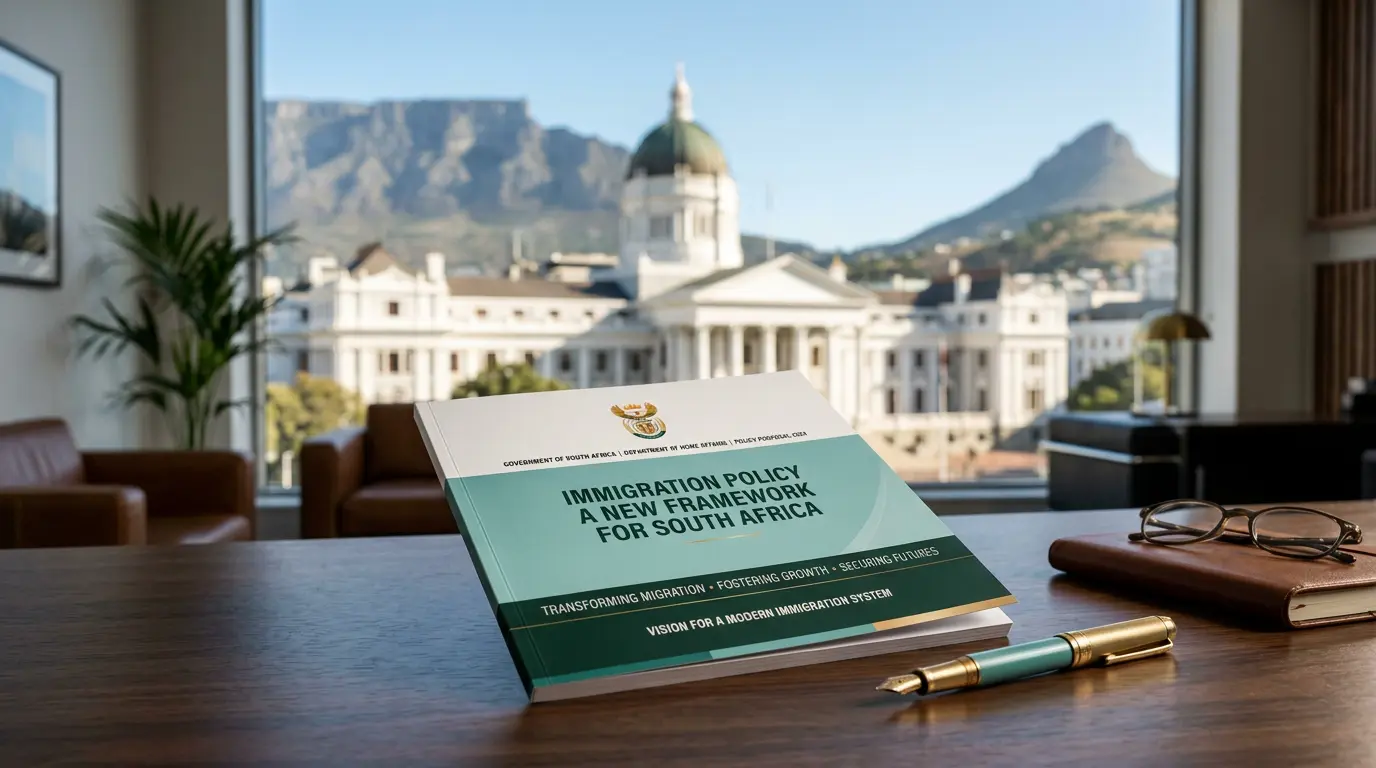

Key Takeaway
On **12 December 2025**, the Department of Home Affairs published the revised draft White Paper on Citizenship, Immigration and Refugee Protection. This is the government's blueprint for overhauling South Africa's entire immigration and citizenship framework.
White Paper & Upcoming Reforms - South Africa Immigration
REVISED WHITE PAPER ON CITIZENSHIP, IMMIGRATION AND REFUGEE PROTECTION
Overview
On 12 December 2025, the Department of Home Affairs published the revised draft White Paper on Citizenship, Immigration and Refugee Protection. This is the government's blueprint for overhauling South Africa's entire immigration and citizenship framework.
Public comment period: 12 December 2025 to 15 February 2026 (extended from original 31 January 2026 deadline)
Core Philosophy
The White Paper reframes citizenship and immigration as:
- Economic enabler: Attracting skills, investment, and innovation
- Security function: Protecting borders and national interests
- Public interest: Balancing openness with control
KEY PROPOSALS
1. Skilled Worker Visa Consolidation
Current system: Separate Critical Skills and General Work visas Proposed: Single "Skilled Worker Visa"
- Merges Critical Skills and General Work visas into one category
- Initially employer-sponsored
- Pathway to self-sponsorship for permanent residency
- Points-based assessment retained
- Simplifies the work visa landscape
2. Startup Visa
New standalone visa class:
- Targeted at highly skilled persons with innovative entrepreneurial ideas
- Must demonstrate contribution to South Africa's economy
- Separate from the Business Visa (Section 15)
- Lower capital requirements than Business Visa
- Innovation and scalability focus
- May include incubator/accelerator partnerships
- Modeled on similar programs in other countries (UK, Canada, Netherlands)
3. Trusted Employer Scheme (Expanded)
Current: 20 bonus points for employees of trusted employers Proposed expansion:
- Full formal scheme with application and certification process
- Faster processing for trusted employer applications
- Reduced documentation requirements
- Streamlined renewals
- Regular compliance monitoring
- Potential for blanket approvals for certain positions
- Employer must meet strict compliance criteria
4. Digital Transformation
- Full ETA rollout: Electronic Travel Authorisation for all visa nationals
- Digital One-Stop-Shop: Single platform for all immigration services
- AI-powered processing: Automated assessment and risk scoring
- Biometric integration: Facial recognition at ports of entry
- Interoperability: Integration with SARS, Labour, CIPC, SAPS databases
- Real-time tracking: Applicants can track applications in real-time
5. Refugee and Asylum System Reform
- Process efficiency improvements to reduce backlogs
- Time limits on asylum processing
- Stronger measures against abuse of the system
- Better integration support for recognized refugees
- Clearer pathways from refugee status to permanent residency
- Digital asylum application processing
- Reform of Refugee Reception Offices
6. Citizenship Reforms
- Streamlined naturalization process
- Clearer rules on dual citizenship
- Addressing statelessness
- Children's citizenship rights
- Citizenship by investment considerations
7. Points-Based System Refinement
- Continuation and improvement of the 2024 points system
- Potential adjustment of scoring criteria
- Dynamic Critical Skills List (more frequently updated)
- Industry input into skills determination
8. Border Management
- Strengthening the Border Management Authority (BMA)
- Technology-driven border control
- Integration of immigration, customs, and security
- Smart border posts
IMMIGRATION AMENDMENT BILL (B8-2024)
Background
The Constitutional Court declared sections 34(1)(b) and 34(1)(d) of the Immigration Act constitutionally invalid. These sections dealt with the arrest and detention of illegal foreigners without adequate judicial oversight.
What the Bill Addresses
- Section 34 reform: New provisions for arrest and detention of illegal foreigners
- 48-hour rule: Any illegal foreign national detained for deportation must be brought before a court in person within 48 hours of arrest
- Judicial oversight: Court must determine whether further detention is in the interests of justice before authorizing continued detention and deportation
- Due process: Ensures constitutional compliance for detention procedures
- Rights protection: Detained persons have right to legal representation
VisaFlow
Want to automate your visa workflow?
Join hundreds of South African immigration firms using VisaFlow to manage cases, documents, and clients.
Learn more →Parliamentary Progress
| Date | Event |
|---|---|
| 2024 | Bill introduced to Parliament |
| 11 September 2025 | Passed by National Assembly |
| 17 December 2025 | Passed by National Council of Provinces (NCOP) |
| February 2026 | Awaiting Presidential assent |
| TBD | Enactment into law |
Implications
- Once signed by the President, becomes law
- DHA must implement new detention procedures
- Immigration officers must comply with 48-hour rule
- Training required for enforcement officials
- Court system must accommodate increased hearings
- Legal aid implications for detained foreigners
2024 REGULATION AMENDMENTS (May 2024)
The Minister promulgated amended Immigration Regulations on 20 May 2024 (effective 9 October 2024). Key changes:
1. Points-Based System
- New system for General Work and Critical Skills visas
- 100-point minimum threshold
- Scoring based on qualifications, salary, experience, language, employer status
- See file: 04-points-based-system.md for full details
2. Remote Worker Visa
- New sub-category of Visitor's Visa
- Allows work for foreign employer while residing in SA
- Minimum annual earnings: R1,000,000
- Proof of foreign employment required
- Medical insurance required
- No right to work for SA employer
3. Police Clearance Certificate Changes
- Redefined legal definition
- Only required from countries where applicant lived 12+ months after age 18 during the 5 years immediately preceding the application
- Reduced burden on applicants who lived in many countries briefly
4. Medical Requirements
- Radiological report removed: No longer required to provide chest X-ray report
- Medical report still required (registered medical practitioner, not older than 6 months)
5. Labour Market Test Waiver
- Certificate from Department of Employment and Labour officially waived
- No longer need to prove no suitable SA candidate available
- Points-based system replaces subjective labour market assessment
6. SAQA Evaluation Waiver
- Applicants with proof of SAQA submission may receive 12-month visa
- Full 5-year visa issued once SAQA evaluation complete
- Addresses chronic SAQA processing delays
7. Professional Body Registration Waiver
- Proof of application for registration accepted initially
- Must complete registration within 12 months
- Addresses delays in professional body registration processes
MINISTER LEON SCHREIBER'S PRIORITIES
Background
Dr. Leon Schreiber was appointed Minister of Home Affairs in the Government of National Unity (GNU) formed after the 2024 elections. Previously a DA member and academic.
Key Priorities
- Digital transformation: Making DHA a technology-driven department
- ETA rollout: Modernizing visa processing with electronic authorization
- Skills attraction: Making SA more attractive to skilled foreign workers
- Corruption clean-up: Addressing corruption within DHA (SIU investigation)
- Processing efficiency: Reducing backlogs and processing times
- Policy reform: White Paper development and implementation
- Border security: Strengthening border management
- Tourism facilitation: Easier entry for tourists (visa-free expansion)
Notable Statements
- Immigration should serve as an economic enabler
- SA needs to compete globally for talent
- Digital systems reduce corruption and improve efficiency
- The White Paper represents a complete reimagining of the immigration system
STATE OF THE NATION ADDRESS (SONA) 2026 - IMMIGRATION IMPLICATIONS
Key Points
- President Ramaphosa highlighted immigration as a priority
- Illegal immigration "poses a risk to security, stability and economic progress"
- Department of Employment and Labour ramping up workplace inspections
- Multi-departmental enforcement operations (DHA + Labour + SAPS)
- Focus on both attracting skills AND enforcing compliance
- Support for Minister Schreiber's reform agenda
Enforcement Actions Following SONA
- Large-scale, multi-departmental operations across the country
- Newcastle textile belt operation (February 2026):
- 34 undocumented foreign nationals arrested
- 2 employers arrested for employing illegal foreigners
- Similar operations in other provinces
TIMELINE OF EXPECTED CHANGES
| Timeframe | Expected Development |
|---|---|
| Q1 2026 | Immigration Amendment Bill signed into law (Presidential assent) |
| Q1-Q2 2026 | White Paper public consultation analysis completed |
| Q2-Q3 2026 | ETA expanded to additional countries and ports |
| Q3-Q4 2026 | Finalized White Paper published |
| 2026-2027 | New Immigration Bill drafted based on White Paper |
| 2027+ | New comprehensive immigration legislation introduced |
| Ongoing | ETA phased expansion continues |
| Ongoing | Digital transformation of DHA services |
| Ongoing | Trusted Employer Scheme formalization |
DHA CORRUPTION INVESTIGATION
SIU Probe (2026)
- Special Investigating Unit (SIU) interim report on DHA
- Revealed a "nefarious syndicate" of officials
- Officials allegedly sold visas and permanent residence permits
- Exploited roles in visa processing and adjudication for profit
- Multi-million rand corruption scheme
- Investigations ongoing
- Criminal prosecutions expected
- Digital systems proposed as anti-corruption measure
Impact on Immigration System
- Increased scrutiny of visa adjudication
- Additional verification steps being implemented
- Digital audit trails being introduced
- Staff changes and disciplinary actions
- Potential delays during investigation period
- Trust deficit in the system