
Key Takeaway
All foreign documents submitted in support of South African visa and permit applications must be properly legalized, authenticated, or certified before the Department of Home Affairs (DHA) will accept them. This requirement exists to verify the authenticity of documents issued by foreign authorities and to prevent fraud in the immigration system.
Document Legalization, Authentication, and Certification Requirements for South African Immigration
Overview
All foreign documents submitted in support of South African visa and permit applications must be properly legalized, authenticated, or certified before the Department of Home Affairs (DHA) will accept them. This requirement exists to verify the authenticity of documents issued by foreign authorities and to prevent fraud in the immigration system.
There are three main systems governing document verification:
- Apostille (for countries party to the Hague Apostille Convention)
- Authentication/Legalization (for countries NOT party to the Hague Convention)
- Certification and Notarization (for copies of documents within South Africa)
Getting document legalization wrong is one of the most common reasons for visa refusal in South Africa. Immigration practitioners must ensure every foreign document is properly legalized before submission, as DHA adjudicators routinely reject applications where documents lack apostille certificates, proper authentication chains, or valid certified copies. This guide provides comprehensive guidance on navigating each system.
The Apostille System (Hague Convention)
Background
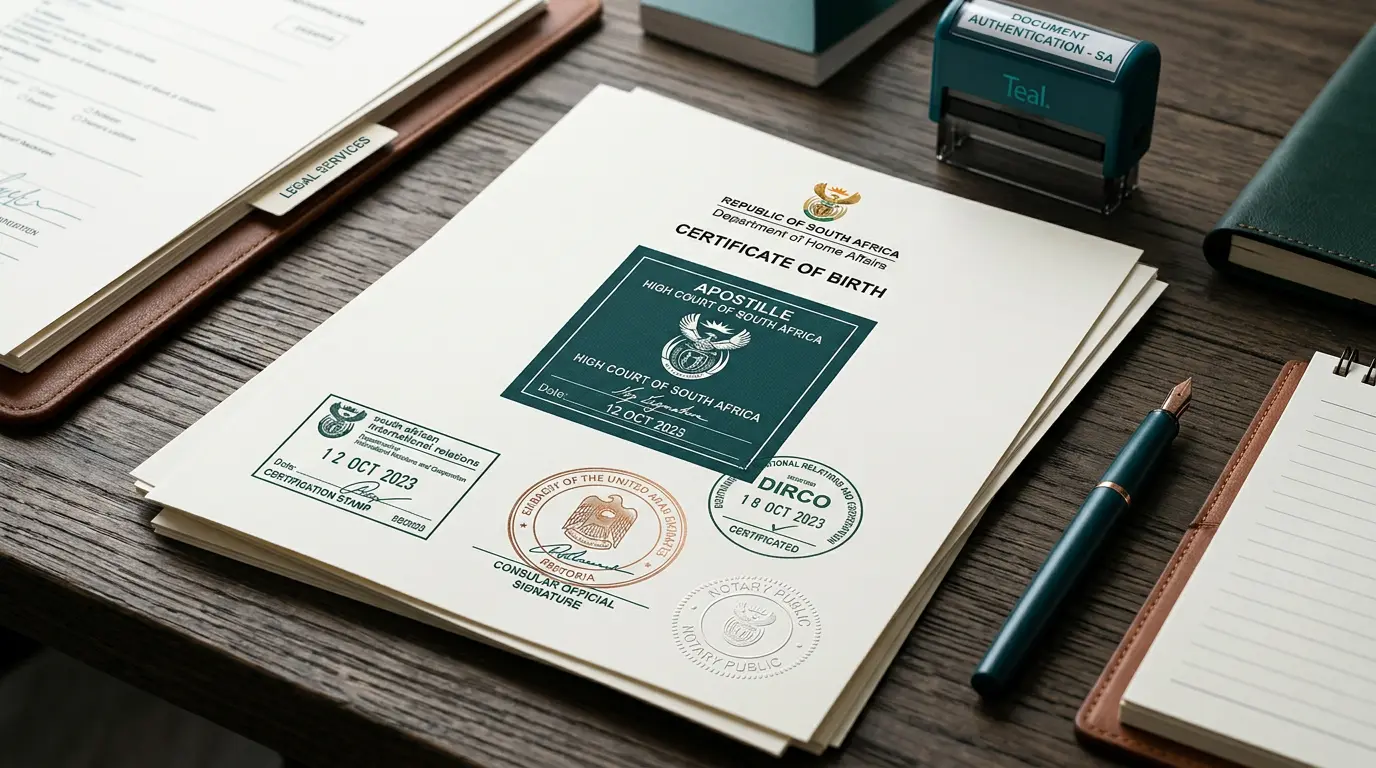
South Africa acceded to the Hague Convention Abolishing the Requirement of Legalisation for Foreign Public Documents (the Apostille Convention) on 30 April 1995. An apostille is a standardised certificate issued by a designated "competent authority" in the country where the document originated, verifying the authenticity of the signature, the capacity in which the person signing acted, and (where applicable) the identity of the seal or stamp on the document.
An apostille issued by one Hague Convention member country is recognised by all other member countries without any further legalization. As of 2026, over 120 countries are parties to the convention.
How the Apostille System Works
- A public document is issued in Country A (a Hague Convention member state).
- The applicant takes the document to the designated competent authority in Country A.
- The competent authority verifies the document and attaches an apostille certificate (a square-format certificate of at least 9 x 9 cm).
- The apostilled document is then accepted in South Africa (and all other Hague member states) without further legalization.
Documents That Typically Require Apostille
- Foreign marriage certificates
- Foreign birth certificates (including unabridged birth certificates for minor children)
- Foreign police clearance certificates
- Foreign qualifications and degrees (university transcripts, diplomas, certificates)
- Court orders from foreign courts (divorce decrees, custody orders, adoption orders)
- Foreign corporate documents (company registration certificates, board resolutions, memoranda of incorporation)
- Foreign death certificates (relevant for spousal or dependent applications)
- Notarial certificates and affidavits from foreign jurisdictions
Where to Obtain an Apostille
Each Hague Convention member country designates one or more competent authorities to issue apostilles. Common examples include:
| Country | Competent Authority |
|---|---|
| United Kingdom | Foreign, Commonwealth & Development Office (FCDO) |
| United States | Secretary of State of the relevant US state |
| India | Ministry of External Affairs (MEA) via regional offices |
| Germany | President of the Regional Court (Landgericht) or state authority |
| France | Procureur Général (Prosecutor General) at the Court of Appeal |
| Australia | Department of Foreign Affairs and Trade (DFAT) |
| Nigeria | High Court of the relevant state (since Nigeria's 2023 accession) |
| Zimbabwe | Ministry of Justice, Legal and Parliamentary Affairs |
| China (mainland) | Provincial/municipal foreign affairs offices |
South African Documents Going Abroad
For South African documents that need to be apostilled (e.g., SA police clearance being submitted to a foreign government), the competent authority is the Department of International Relations and Cooperation (DIRCO) located in Pretoria. DIRCO's Authentication Unit handles all apostille requests for SA-issued documents.
- Address: DIRCO, OR Tambo Building, 460 Soutpansberg Road, Rietondale, Pretoria
- Cost: Varies (currently nominal; check DIRCO website for updated schedule)
- Timeline: 5-10 working days for standard processing
Cost and Timeline for Apostilles
- Cost: Varies by country, typically USD 10-50 per document
- Timeline: Ranges from same day to 4 weeks depending on the country and competent authority
- Tip: Some countries offer expedited processing for an additional fee
Authentication (Non-Hague Convention Countries)
When Authentication Applies
For countries that are NOT party to the Hague Apostille Convention, the apostille system does not apply. Instead, documents must go through a more complex process known as authentication or legalization. This is common for documents from:
- Democratic Republic of Congo (DRC)
- Somalia
- Ethiopia (acceded in 2024, but implementation may vary)
- Some Middle Eastern countries (though many have joined the Convention in recent years)
- Several African countries that have not yet acceded
The Authentication Process
The typical authentication chain for non-Hague countries involves three steps:
- Notarization in the country of origin: A notary public or authorised official in the issuing country certifies the document.
- Authentication by the Ministry of Foreign Affairs (or equivalent) of the issuing country: The foreign ministry confirms the notary's credentials and the document's authenticity.
- Legalization by the South African embassy or consulate in the issuing country: The SA diplomatic mission in that country verifies the foreign ministry's authentication and affixes its own stamp/seal.
Alternatively, if there is no SA embassy in the issuing country, the document may be authenticated by the foreign embassy or consulate in South Africa, though this is less common and may require additional steps.
Practical Considerations
- This process is significantly more complex and time-consuming than apostille.
- Allow 4-8 weeks for the full authentication chain.
- If the applicant is already in SA, they may need to send documents back to their home country for authentication or use a trusted agent/family member.
- DHA adjudicators will reject documents from non-Hague countries that only have a notarial stamp without the full authentication chain.
Certified Copies
Requirements
Many visa application documents must be submitted as certified copies rather than originals. This protects the applicant's original documents from loss while allowing DHA to verify them.
How to Certify Documents in South Africa
A certified copy is made by a Commissioner of Oaths, who compares the copy to the original document, stamps it, and signs it as a true copy of the original. Commissioners of Oaths in South Africa include:
- South African Police Service (SAPS) members at any police station (most common method)
- Attorneys and notaries public
- Magistrates
- Justices of the Peace
- Certain designated public officials
Validity Period
- Certified copies are valid for 3 months (90 days) from the date of certification.
- If the visa application takes longer than 3 months to process and DHA requests updated documents, you may need to re-certify the copies.
- Important: Track the certification dates of all documents in the application file to avoid expiry during processing.
Practical Tips
- Certify multiple copies at once (at least 3-4 copies of each document).
- Keep originals in a secure location; never submit originals to VFS/DHA unless specifically required.
- Ensure the Commissioner's stamp includes the date, name, designation, and signature.
- Copies must be clear and legible; DHA may reject poorly photocopied documents even if properly certified.
Sworn Translations
When Required
All documents not in English that are submitted with a South African visa application must be accompanied by a sworn translation into English. South Africa has 11 official languages, but DHA operates primarily in English for immigration matters.
Who Can Provide Sworn Translations
VisaFlow
Want to automate your visa workflow?
Join hundreds of South African immigration firms using VisaFlow to manage cases, documents, and clients.
Learn more →A sworn translation must be done by a sworn translator who is registered with the High Court of South Africa. The sworn translator:
- Takes an oath or affirmation before the High Court confirming their competence in the relevant language pair.
- Signs an affidavit confirming the accuracy and completeness of each translation.
- Attaches their sworn translator stamp/seal to the translated document.
DHA rejects informal or uncertified translations. Translations by friends, family members, or unregistered translators will not be accepted.
Common Languages Requiring Translation
| Language | Common Source Countries |
|---|---|
| French | DRC, Cameroon, Senegal, Ivory Coast, Republic of Congo |
| Portuguese | Mozambique, Angola, Brazil |
| Chinese (Mandarin/Cantonese) | China, Taiwan, Hong Kong |
| Arabic | Egypt, Libya, Middle Eastern countries |
| Hindi/Urdu | India, Pakistan |
| Amharic | Ethiopia |
| Swahili | Tanzania, Kenya, DRC |
| Spanish | Latin American countries |
Cost and Finding Sworn Translators
- Cost: Approximately R150-R500+ per page, depending on the language, complexity, and urgency.
- Finding sworn translators: High Court register (available at court offices), ProZ.com (online translator directory), professional translation agencies, Law Society referrals.
- Submission: Both the original language document and the sworn English translation must be submitted together.
SAQA Evaluation of Foreign Qualifications
Purpose
The South African Qualifications Authority (SAQA) evaluates foreign qualifications against the National Qualifications Framework (NQF) to determine their South African equivalence. This evaluation is a critical requirement for many visa categories.
When SAQA Evaluation Is Required
- Work visas: Critical Skills Visa and General Work Visa (under the Points-Based System)
- Permanent residency: Certain categories under Sections 26 and 27
- Professional registration: Many professional bodies require SAQA evaluation as a prerequisite
The SAQA Evaluation Process
- Apply online via SAQA's Document Verification and Foreign Qualification Evaluation Advisory Service (DFQEAS) portal: https://dfqeas.saqa.org.za
- Upload certified copies of qualifications and academic transcripts.
- SAQA contacts the issuing institution directly to verify the qualification's authenticity.
- SAQA issues a Statement of Comparison and Evaluation (SCoE) mapping the qualification to the relevant NQF level.
NQF Level Mapping
| NQF Level | SA Equivalent | Typical Foreign Equivalent |
|---|---|---|
| NQF 5 | Higher Certificate / Diploma | Associate degree, HND |
| NQF 6 | Advanced Diploma / 3-year Bachelor's | 3-year undergraduate degree |
| NQF 7 | Bachelor's Degree | 4-year Bachelor's, Honours (some countries) |
| NQF 8 | Honours / Postgraduate Diploma | Postgraduate certificate, some Master's |
| NQF 9 | Master's Degree | Master's degree |
| NQF 10 | Doctoral Degree | PhD, Doctorate |
Processing Time and Cost
- Processing time: 3-6 months (SAQA has a significant backlog; some cases take longer)
- Cost: R1,460 per qualification (2025/2026 fee schedule)
- Expedited processing: Not generally available; applications are processed in order of receipt
Partial Waiver Under the Points-Based System
The October 2024 Points-Based System (PBS) introduced a partial waiver of SAQA evaluation for certain categories where points are earned through other criteria (e.g., high salary, extensive experience, Trusted Employer sponsorship). However, practitioners should confirm the specific waiver provisions applicable to each case.
Common Issues
- Institution not recognised by SAQA: Some foreign institutions, particularly private colleges or distance-learning providers, may not be in SAQA's database.
- Qualification not comparable: The foreign qualification may not align neatly with SA NQF levels, resulting in a lower-than-expected rating.
- Transcripts unavailable: If the issuing institution has closed or merged, obtaining verification can be extremely difficult.
- Verification delays: Institutions in some countries are slow to respond to SAQA's verification requests.
- Appeal process: Applicants can appeal SAQA evaluation outcomes through SAQA's internal appeals mechanism. The appeal must be lodged within 60 days of receiving the evaluation.
Professional Body Registration
Overview
For regulated professions in South Africa, foreign nationals must register with the relevant South African professional body before (or concurrent with) their visa application. This ensures that foreign professionals meet South African professional standards.
Key Professional Bodies
| Professional Body | Acronym | Professions Covered |
|---|---|---|
| Engineering Council of SA | ECSA | Engineers, technologists, technicians |
| Health Professions Council of SA | HPCSA | Doctors, dentists, psychologists, radiographers, etc. |
| SA Nursing Council | SANC | Nurses and midwives |
| SA Council for the Architectural Profession | SACAP | Architects |
| SA Council for Project and Construction Management Professions | SACPCMP | Project managers, construction managers |
| SA Institute of Chartered Accountants | SAICA | Chartered accountants (CA(SA)) |
| SA Institute of Professional Accountants | SAIPA | Professional accountants |
| Legal Practice Council | LPC | Attorneys and advocates |
| SA Council for Natural Scientific Professions | SACNASP | Scientists (various disciplines) |
| Institute of IT Professionals SA | IITPSA | IT professionals |
General Registration Process
- Apply to the professional body with qualifications, academic transcripts, and proof of professional experience.
- The body verifies qualifications (may involve SAQA evaluation, additional exams, or a period of supervised practice).
- The body issues a registration certificate or letter of good standing.
- Submit the registration certificate/letter with the visa application.
Timeline and Cost
- Timeline: 2-12 months depending on the profession and professional body. Medical professionals (HPCSA) and engineers (ECSA) tend to have longer processing times.
- Cost: R500 - R15,000+ depending on the body and registration category. Some bodies charge separate application, evaluation, and registration fees.
Important Notes
- Some professional bodies require the applicant to pass board examinations before granting registration (particularly HPCSA for medical doctors).
- Temporary registration may be available for professionals awaiting full registration, allowing them to commence work under supervision.
- Registration must be maintained through annual renewals and continuing professional development (CPD) requirements.
Police Clearance Certificates
General Requirement
Police clearance certificates are required from every country where the applicant has lived for 12 months or more during the preceding 5 years. This is a standard requirement across most visa categories including work visas, permanent residency, and some long-term visitor visas.
South African Police Clearance (SAPS)
- Where to apply: Any SAPS police station (Criminal Record Centre processes the application centrally)
- Form: SAPS 91(a)
- Requirements: Valid identification document, fingerprints taken at the police station
- Cost: R190
- Processing time: 10-15 working days
- Validity: 6 months from date of issue
- Collection: Collected from the police station where the application was submitted, or can be posted
Foreign Police Clearance Certificates
The process for obtaining police clearance varies significantly by country. Some countries allow applications from abroad; others require the applicant to be physically present. Common challenges include:
- Countries with no centralised criminal record system
- Countries experiencing conflict or institutional collapse
- Long processing times (some countries take 3-6 months)
- Language barriers (certificates may not be in English)
Apostille and Authentication
Foreign police clearance certificates must be apostilled (if from a Hague Convention country) or authenticated (if from a non-Hague country) before submission to DHA. An unapostilled or unauthenticated foreign police clearance will be rejected.
Validity
Most immigration authorities accept police clearance certificates that are within 6 months of the date of issue, though some categories allow up to 12 months. Practitioners should confirm the applicable validity period for each visa category and plan accordingly.
Medical Reports
Form DHA-811
The standard medical report form for South African visa applications is Form DHA-811 (Medical Report). This form must be completed by a registered medical practitioner (doctor registered with the HPCSA or equivalent body in the applicant's country).
What the Medical Report Covers
- General health assessment: Physical examination findings, medical history, current medications
- TB screening: Chest examination; referral for further testing if indicated
- Communicable diseases: Assessment for diseases of public health significance
Validity
- Valid for 6 months from the date of the medical examination.
Key Changes and Clarifications
- Radiological report requirement WAIVED: Since the May 2024 regulation amendment, the requirement for a separate radiological (chest X-ray) report has been waived. The DHA-811 medical report is now sufficient on its own.
- Yellow fever vaccination certificate: Required if arriving from or transiting through a yellow fever endemic country (as designated by the WHO). This is a port-of-entry requirement, not a visa application requirement, but practitioners should advise clients to obtain it.
- HIV testing: NOT required for visa applications. This is a common misconception. South African immigration law does not require HIV testing, and HIV-positive status is not grounds for visa refusal.
Practical Tips for Immigration Practitioners
- Start document preparation at least 6 months before the intended visa application date. SAQA evaluation alone can take 3-6 months.
- Check the apostille status of each country involved in the application. Verify whether each country is a Hague Convention member and plan the legalization route accordingly.
- Certify extra copies of everything (minimum 3-4 sets). Certifications expire after 3 months, and having backup copies prevents delays.
- Track certification expiry dates in a spreadsheet or case management system. Recertify before expiry if processing is delayed.
- Use only registered sworn translators. DHA rejects informal translations, and submitting an unregistered translation wastes time and fees.
- Apply for SAQA evaluation as the very first step in the process. It is invariably the longest-running task and should be initiated before all other document preparation.
- Never submit original documents to VFS/DHA unless the specific visa category explicitly requires originals. Certified copies should be the default submission format.
- Maintain a complete duplicate file of every document submitted. If documents are lost during processing (which does happen), having duplicates allows rapid resubmission.
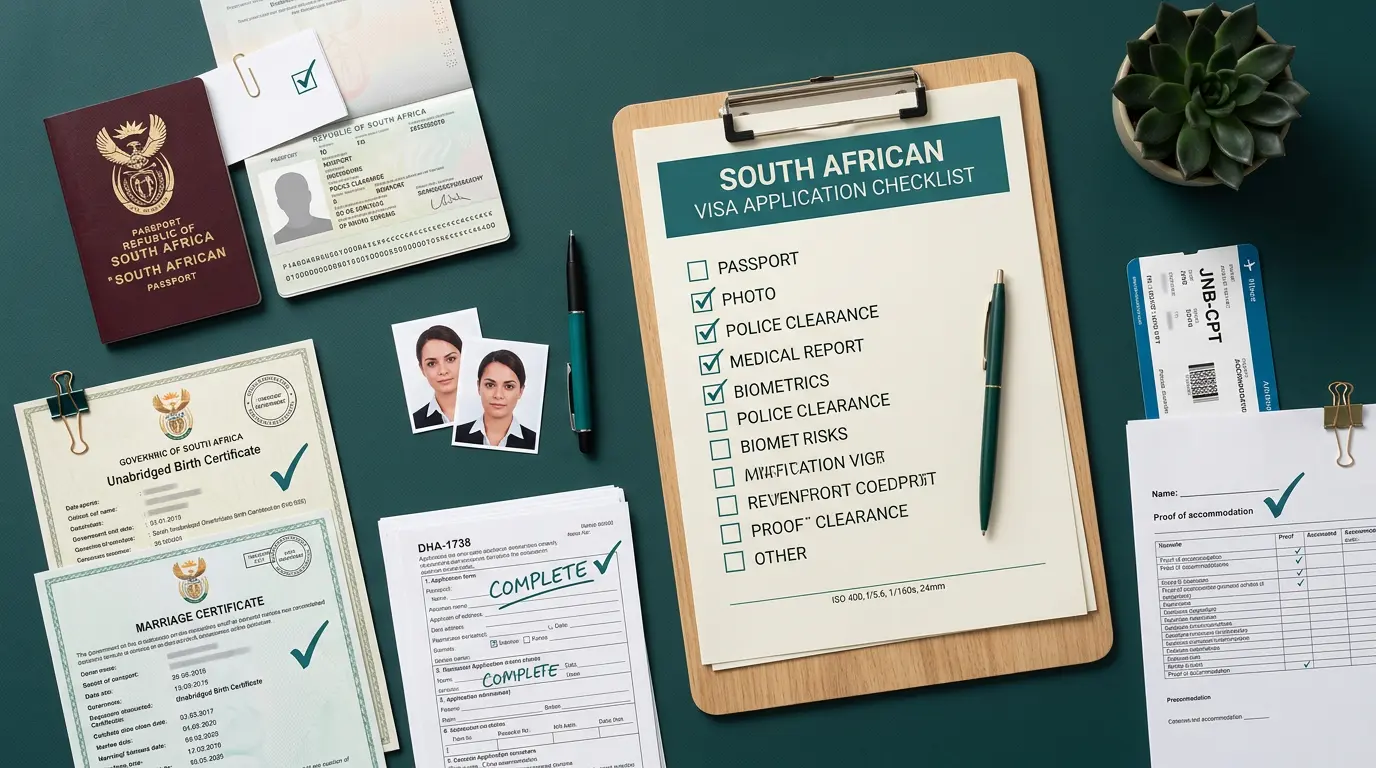
- Compile a document index/checklist for every VFS submission. This helps the VFS counter staff verify completeness and creates a record of what was submitted. Number each document to match the checklist.
- Advise clients on document safekeeping. Original passports, qualifications, and certificates should be stored securely, with copies readily accessible.
KEY SOURCES
- Hague Conference on Private International Law (HCCH) - Apostille Convention status table: https://www.hcch.net/en/instruments/conventions/status-table/?cid=41
- DIRCO (Department of International Relations and Cooperation) - Authentication/Apostille services: https://www.dirco.gov.za
- SAQA (South African Qualifications Authority) - Foreign Qualification Evaluation: https://dfqeas.saqa.org.za
- SAQA NQF Level Descriptors: https://www.saqa.org.za/nqf-level-descriptors
- Immigration Act 13 of 2002 (as amended) - Document requirements: https://www.gov.za/documents/immigration-act
- Immigration Regulations, 2014 (as amended, including May 2024 amendments) - Regulation 6 (medical requirements), Regulation 7 (police clearance): Government Gazette
- SAPS Criminal Record Centre - Police clearance applications: https://www.saps.gov.za
- HPCSA (Health Professions Council of SA): https://www.hpcsa.co.za
- ECSA (Engineering Council of SA): https://www.ecsa.co.za
- SANC (SA Nursing Council): https://www.sanc.co.za
- LPC (Legal Practice Council): https://lpc.org.za
- SAICA (SA Institute of Chartered Accountants): https://www.saica.co.za
- ProZ.com - Sworn translator directory: https://www.proz.com
- VFS Global South Africa - Document submission requirements: https://visa.vfsglobal.com/zaf/en/zaf