
Key Takeaway
South Africa has **71 designated ports of entry** through which persons may lawfully enter or depart the Republic. These comprise 52 land border posts, 10 airports, and 9 seaports. All ports of entry are managed by the Department of Home Affairs (DHA) and the Border Management Authority (BMA), with support from the South African Revenue Service (SARS) for customs and the National Department of Health for health screening. Entry and exit procedures are governed by the Immigration Act 13 of 2002, the Immigration Regulations, and various operational directives.
Port of Entry Procedures - South Africa
Overview
South Africa has 71 designated ports of entry through which persons may lawfully enter or depart the Republic. These comprise 52 land border posts, 10 airports, and 9 seaports. All ports of entry are managed by the Department of Home Affairs (DHA) and the Border Management Authority (BMA), with support from the South African Revenue Service (SARS) for customs and the National Department of Health for health screening. Entry and exit procedures are governed by the Immigration Act 13 of 2002, the Immigration Regulations, and various operational directives.
Key legislation:
- Immigration Act 13 of 2002, Sections 9-11 (entry, sojourn, and departure)
- Immigration Regulations, 2014
- Border Management Authority Act 2 of 2020
- International Health Regulations (WHO) - as applied by the National Department of Health
PORTS OF ENTRY - OVERVIEW
| Type | Number | Notes |
|---|---|---|
| Land border posts | 52 | Distributed across all land-neighbouring countries |
| Airports | 10 | International airports with immigration facilities |
| Seaports | 9 | Commercial and cruise terminals |
| Total | 71 |
MAJOR AIRPORTS
International Airports Table
| Airport | IATA Code | Location | Key Features |
|---|---|---|---|
| OR Tambo International Airport | JNB | Johannesburg, Gauteng | Largest and busiest in Africa; primary international gateway; ETA system operational; full biometric processing |
| Cape Town International Airport | CPT | Cape Town, Western Cape | Second-busiest; e-gate trial operational; major tourism gateway |
| King Shaka International Airport | DUR | Durban, KwaZulu-Natal | Third-busiest; regional and international flights; growing route network |
| Lanseria International Airport | HLA | Johannesburg North, Gauteng | Secondary Johannesburg airport; ETA system operational; limited international routes |
| Kruger Mpumalanga International Airport | MQP | Nelspruit, Mpumalanga | Gateway to Kruger National Park; seasonal tourism traffic; limited international flights |
| Bram Fischer International Airport | BFN | Bloemfontein, Free State | Limited international traffic; primarily domestic |
| Port Elizabeth Airport | PLZ | Gqeberha, Eastern Cape | Renamed; limited international connections |
| Upington International Airport | UTN | Upington, Northern Cape | Primarily domestic; occasional international charters |
| Polokwane International Airport | PTG | Polokwane, Limpopo | Limited international services |
| Pilanesberg International Airport | NTY | North West Province | Tourism-focused; charter traffic to Sun City |
Airport Processing
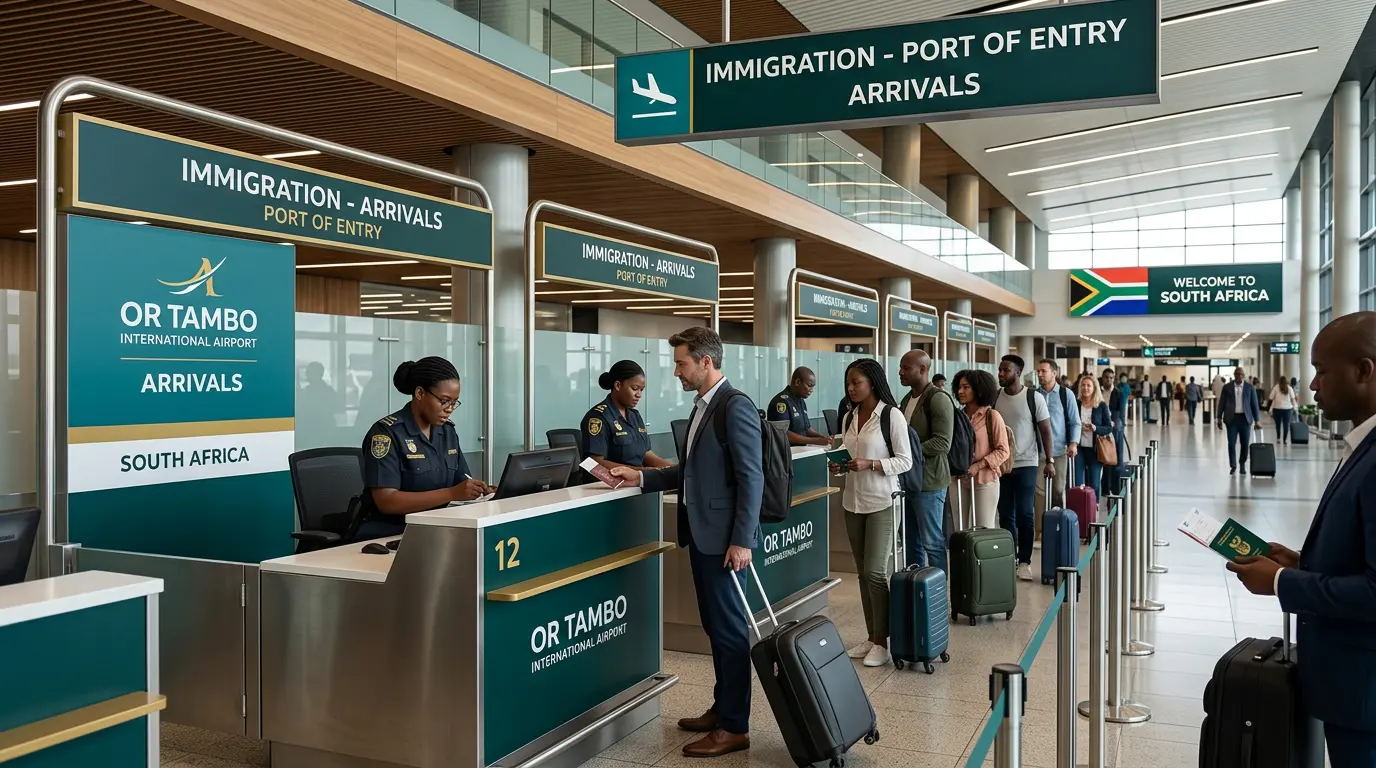
At international airports, the immigration process follows a standard flow:
- Arrival: Passenger disembarks and proceeds to immigration hall
- Queue allocation: Separate queues for SA citizens/permanent residents and foreign nationals
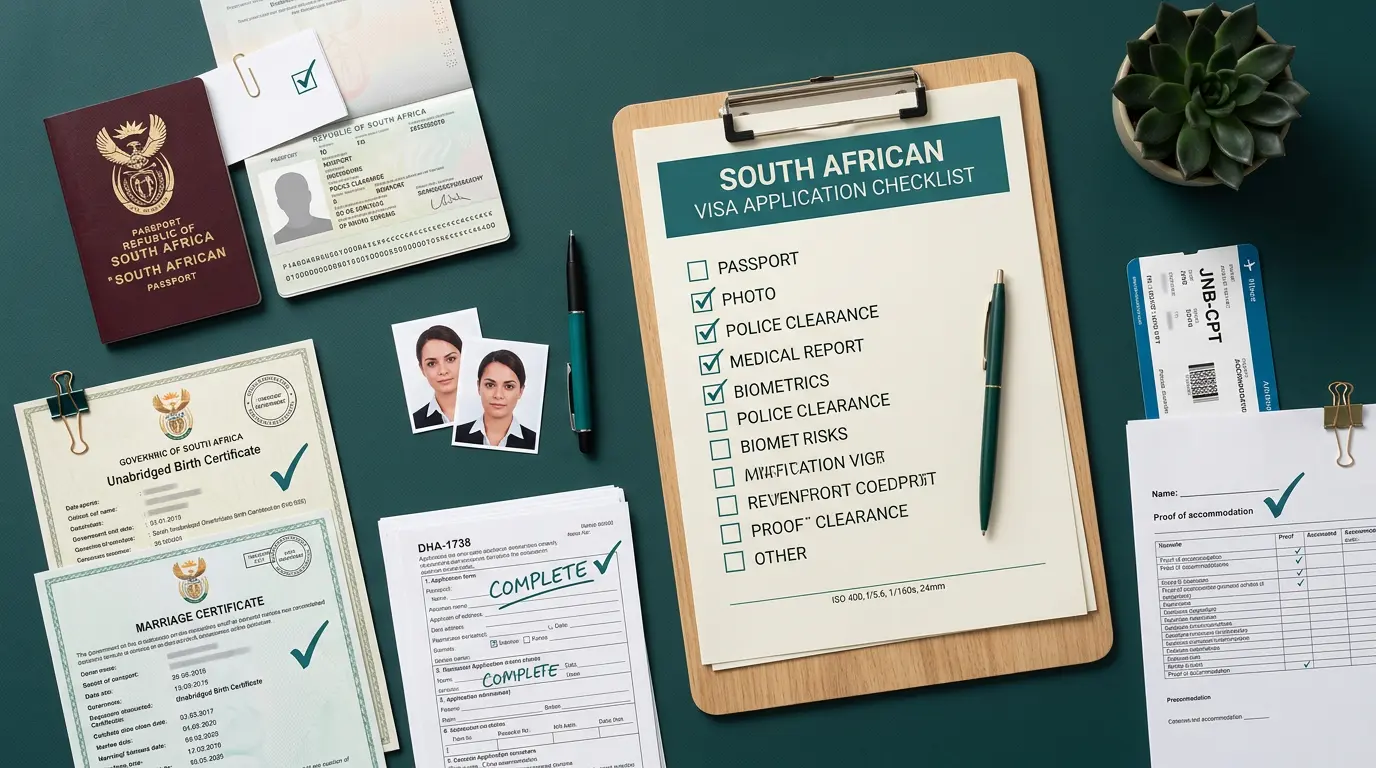
- Document check: Passport, visa (if applicable), return ticket, proof of accommodation
- Biometric capture: Fingerprints and/or facial recognition (where operational)
- Entry stamp: Immigration officer stamps passport with date, port of entry, and conditions
- Customs: Proceed to SARS customs for goods declaration
- Health screening: If applicable (e.g., yellow fever certificate requirement from endemic countries)
MAJOR LAND BORDER POSTS
Key Land Border Posts Table
| Border Post | Neighbouring Country | Operating Hours | Province | Key Features |
|---|---|---|---|---|
| Beitbridge | Zimbabwe | 24 hours | Limpopo | Largest land border crossing in Southern Africa; major commercial corridor; upgrade project underway |
| Lebombo / Ressano Garcia | Mozambique | 06:00 - 24:00 | Mpumalanga | Maputo Corridor; One-Stop Border Post (OSBP) pilot; heavy commercial traffic |
| Oshoek / Ngwenya | Eswatini | 24 hours | Mpumalanga | ~600 trucks daily; connects to Mbabane and Manzini |
| Maseru Bridge | Lesotho | 24 hours | Free State | Main Lesotho crossing; high daily commuter traffic; 1 of 13 Lesotho border posts |
| Kopfontein / Tlokweng | Botswana | 06:00 - 22:00 | North West | Near Gaborone; high business and personal traffic |
| Vioolsdrif / Noordoewer | Namibia | 24 hours | Northern Cape | Crosses the Orange River; connects to southern Namibia |
| Skilpadshek / Pioneer Gate | Botswana | 06:00 - 22:00 | North West | Trans-Kalahari Highway; commercial route |
| Nakop / Ariamsvlei | Namibia | 24 hours | Northern Cape | Trans-Kalahari Corridor; commercial traffic |
| Groblersbrug / Martin's Drift | Botswana | 06:00 - 22:00 | Limpopo | Northern Botswana route |
| Ficksburg Bridge | Lesotho | 06:00 - 22:00 | Free State | Second-largest Lesotho crossing |
| Mahamba | Eswatini | 07:00 - 22:00 | Mpumalanga | Southern Eswatini route |
| Caledonspoort | Lesotho | 06:00 - 22:00 | Free State | Eastern Free State crossing |
Land Border Processing
Land border processing differs from airports in several respects:
- Travellers may arrive by vehicle, bus, or on foot
- Vehicle documentation may be inspected (registration, insurance, cross-border permit)
- Commercial vehicles are subject to separate cargo processing lanes
- During peak periods (December/January festive season, Easter), extended operating hours may be gazetted
- One-Stop Border Post (OSBP) facilities (e.g., Lebombo) allow both countries' officials to process travellers in a single stop
MARITIME PORTS
Key Seaports
| Port | Location | Key Features |
|---|---|---|
| Durban | KwaZulu-Natal | Busiest port in Africa by cargo volume; cruise terminal at Durban Cruise Terminal |
| Cape Town | Western Cape | Major cruise ship destination (V&A Waterfront Terminal); gateway for Antarctic expeditions |
| Richards Bay | KwaZulu-Natal | Major coal export terminal; limited passenger traffic |
| Port Elizabeth (Ngqura) | Eastern Cape | Deep-water port; commercial focus |
| East London | Eastern Cape | Automotive export hub; limited passenger traffic |
| Saldanha Bay | Western Cape | Iron ore export; no regular passenger traffic |
| Mossel Bay | Western Cape | Oil and gas; limited immigration activity |
| Simon's Town | Western Cape | Naval base; limited civilian immigration |
| Port Nolloth | Northern Cape | Small port; minimal immigration activity |
Maritime Immigration
- Crew members are processed under the crew visa provisions of the Immigration Act
- Cruise ship passengers may disembark for shore excursions (typically treated as transit)
- Crew list submitted to DHA in advance by the ship's agent
- Maritime immigration officers are stationed at major ports
- Small craft and yachts must report to a designated port of entry upon arrival
ENTRY PROCEDURES
Standard Entry Requirements
All foreign nationals entering South Africa must comply with the following:
| Requirement | Detail |
|---|---|
| Valid passport | Must be valid for at least 30 days beyond the intended departure date |
| Blank pages | Passport must have at least 2 blank pages (for entry/exit stamps) |
| Valid visa | If required for the applicant's nationality (unless visa-exempt) |
| Return/onward ticket | May be requested, especially for visitors |
| Proof of sufficient funds | May be requested to demonstrate ability to sustain stay |
| Proof of accommodation | May be requested, especially for visitor visa holders |
| Yellow fever certificate | Required if arriving from or transiting through a yellow fever endemic country |
Entry Stamp
- Every foreign national admitted to South Africa receives an entry stamp in their passport
- The entry stamp records:
- Date of entry
- Port of entry
- Duration of stay authorised (e.g., "30 days" or "90 days")
- Visa category (if applicable)
- A visa is only valid once stamped at the port of entry - an unstamped visa does not authorise sojourn
- The immigration officer may impose conditions or reduce the authorised duration below the visa validity
- Entry may be refused if the immigration officer is not satisfied with the documentation or purpose of visit
Grounds for Refusal of Entry (Section 29)
An immigration officer may refuse entry if the person:
- Does not hold a valid passport or travel document
- Does not hold the required visa
- Is on the V-List (list of undesirable persons)
- Is flagged by Interpol or other law enforcement agencies
- Cannot demonstrate the purpose of their visit
- Cannot demonstrate sufficient means of support
- Has previously been deported from South Africa
- Poses a security or public health risk
- Has a passport with insufficient blank pages or validity
ADVANCED PASSENGER PROCESSING (APP)
How APP Works
The Advanced Passenger Processing system is a pre-departure screening mechanism:
VisaFlow
Want to automate your visa workflow?
Join hundreds of South African immigration firms using VisaFlow to manage cases, documents, and clients.
Learn more →- Data submission: Airlines electronically submit passenger information (API - Advance Passenger Information) to the DHA before departure
- Information captured: Full name, passport number, nationality, date of birth, flight details, travel document details
- Cross-referencing: DHA systems cross-reference the data against:
- The V-List (list of undesirable persons prohibited from entering SA)
- Interpol databases (stolen and lost travel documents, wanted persons)
- Domestic watchlists (persons of interest to SA law enforcement)
- Response: DHA sends a board/no-board response to the airline
- Flagged persons: Persons flagged are denied boarding by the airline at the point of departure
- Compliance: Airlines that board flagged passengers face penalties under the Immigration Act
APP Coverage
- Operational for all international flights arriving in South Africa
- Airlines are legally required to participate (Section 35 of the Immigration Act)
- Does not apply to land or sea arrivals (separate processing at border posts)
- Supplemented by the Passenger Name Record (PNR) system for enhanced risk profiling
BIOMETRIC MOVEMENT CONTROL SYSTEM (BMCS)
Current Deployment
The DHA is in the process of deploying the Biometric Movement Control System at all 71 ports of entry:
| Feature | Detail |
|---|---|
| Scope | All 71 ports of entry (airports, land, sea) |
| Technology | Fingerprint scanning, facial recognition, document verification |
| Purpose | Verify identity of travellers, detect fraudulent documents, track entries and exits |
| Status | Partially deployed; rollout ongoing |
e-Gates Trial
- Location: Cape Town International Airport (CPT)
- Technology: Automated biometric gates (e-gates) using facial recognition and passport scanning
- Eligible users: Initially limited to SA citizens and permanent residents with biometric passports
- Benefit: Faster processing, reduced queuing, enhanced security
- Expansion: Plans to extend e-gates to OR Tambo International Airport and other major airports
Facial Recognition Expansion
- The DHA has piloted facial recognition technology at select airports
- Integration with the National Population Register for SA citizens
- Integration with the National Immigration Information System (NIIS) for foreign nationals
- Privacy concerns have been raised by civil society organisations regarding biometric data collection and storage
- The Protection of Personal Information Act (POPIA) applies to all biometric data processing
TRANSIT PROCEDURES
Airport Transit
| Feature | Detail |
|---|---|
| Definition | Passing through a South African airport en route to a third country without formally entering SA |
| Maximum duration | 24 hours |
| Transit area | Passengers must remain in the international transit area; may not clear immigration |
| Visa requirement | Visa-exempt for nationals of most countries; visa-requiring nationals must obtain a transit visa |
| Transit visa | Required for nationals of certain countries (listed in Immigration Regulations) |
| Baggage | If checked through to final destination, no need to clear customs |
| Connecting flights | Must be on the same booking or separate bookings with sufficient connection time |
Land Transit
| Feature | Detail |
|---|---|
| Definition | Transiting through South Africa overland to reach a third country |
| Maximum duration | 48 hours |
| Visa requirement | Visa-requiring nationals must obtain a port-of-entry transit visa or apply in advance |
| Entry stamp | Transit travellers receive an entry stamp limiting stay to 48 hours |
| Exit | Must depart SA within 48 hours through a designated port of entry |
| Common routes | Zimbabwe to Mozambique via SA; Lesotho to other destinations (enclave country) |
EXIT PROCEDURES
Standard Departure Process
- Check-in: Airline check-in (airports) or approach border post (land/sea)
- Document presentation: Present passport and boarding pass (airports) or passport (land/sea)
- Immigration check: Officer verifies:
- Identity (passport photo and biometric comparison)
- Immigration status (entry stamp, visa conditions)
- Duration of stay (whether within authorised period)
- Departure stamp: Immigration officer stamps passport with departure date and port
- Overstay check: System automatically calculates days between entry stamp and departure stamp
- Customs: SARS customs exit declaration (if applicable)
Travel Declaration Form
- South Africa introduced an online Travel Declaration form as part of its digital immigration reforms
- The form captures:
- Personal details
- Travel itinerary (origin, destination)
- Accommodation details
- Health declarations (where applicable)
- Contact information in SA
- Initially introduced during COVID-19 and subsequently adapted for ongoing use as a digital entry/exit form
- Can be completed online before travel: https://www.dha.gov.za
Documents Required at Exit
| Document | Required | Notes |
|---|---|---|
| Valid passport | Yes | Must be the same passport used for entry |
| Boarding pass | Yes (airports) | Not applicable for land/sea departures |
| Departure stamp | Applied by officer | Recorded in passport and on the BMCS |
| Travel Declaration | Recommended | Where system is operational |
| Customs declaration | If applicable | For goods exceeding duty-free allowances |
OVERSTAY DETECTION AT EXIT
Automated Overstay Calculation
When a person departs South Africa, the immigration system automatically calculates the number of days stayed by comparing the entry stamp date with the departure date:
| Overstay Duration | Consequence |
|---|---|
| No overstay | Normal departure; no adverse action |
| Up to 30 days | Form 19 issued; entry on V-List; 1-year ban from entering SA |
| More than 30 days | Form 19 issued; entry on V-List; 5-year ban from entering SA |
Form 19 (Notice of Undesirable Person)
- Issued to the foreign national at the port of exit
- Records the overstay details, the person's particulars, and the ban duration
- The person's details are entered on the V-List (list of undesirable persons)
- The V-List is shared with airlines (via APP) and all ports of entry
- The person is permitted to depart but may not re-enter during the ban period
Challenging an Overstay Ban
- A person on the V-List may apply to the Director-General of Home Affairs for removal
- Must provide compelling reasons (e.g., medical emergency, DHA error, humanitarian circumstances)
- An attorney may be required to submit representations
- Processing time for V-List removal applications: 3-12 months (no guaranteed timeline)
- Judicial review is available under PAJA if the DG refuses the application
Common Causes of Overstay
- Unawareness of visa conditions or expiry date
- DHA processing delays (e.g., waiting for visa renewal decision while previous visa expired)
- Incorrect entry stamp duration (officer error)
- Confusion between calendar days and working days
- Reliance on unregistered immigration practitioners who failed to file renewals on time
- Medical emergencies or force majeure
BORDER MANAGEMENT AUTHORITY (BMA)
Establishment and Mandate
The Border Management Authority was established under the BMA Act 2 of 2020 to provide an integrated, coordinated approach to border management:
| Feature | Detail |
|---|---|
| Legislation | Border Management Authority Act 2 of 2020 |
| Parent department | Department of Home Affairs |
| Commissioner | Appointed by the Minister of Home Affairs |
| Mandate | Overall coordination and management of all ports of entry and borders |
| Objective | Single point of authority for border law enforcement and facilitation |
BMA Strategic Plan 2025-2030
Key priorities include:
- Technology modernisation: Full deployment of BMCS at all 71 ports of entry
- Infrastructure upgrade: Physical infrastructure improvements at land border posts (especially Beitbridge, Lebombo)
- One-Stop Border Post (OSBP): Expansion of OSBP model to reduce dual processing at land borders
- Risk-based approach: Shift from blanket checks to intelligence-led, risk-based screening
- Inter-agency coordination: Unified command at each port of entry integrating DHA, SARS, SAPS, and Health
- Maritime domain awareness: Enhanced monitoring of coastal borders and small craft arrivals
- Anti-corruption: Internal integrity measures to combat bribery and corruption at ports of entry
- Capacity building: Training and professionalisation of BMA officials
- Digital borders: Integration with the ETA system and biometric databases for real-time verification
BMA and Immigration Officers
- Immigration officers at ports of entry are now functionally under the BMA
- The BMA does not replace the DHA's policy and adjudication functions (visa decisions remain with DHA)
- The BMA focuses on operational border management: entry/exit processing, enforcement, interdiction
- BMA officials have powers of arrest, search, and seizure under the BMA Act
MULTIPLE AGENCIES AT PORTS OF ENTRY
Agency Roles
At each port of entry, several government agencies operate alongside each other:
| Agency | Function | Key Activities |
|---|---|---|
| DHA / BMA | Immigration | Passport control, visa verification, entry/exit stamps, overstay detection, V-List checks |
| SARS | Customs and excise | Goods declarations, duty collection, smuggling detection, vehicle searches |
| Port Health (NDoH) | Health screening | Yellow fever certificate verification, disease surveillance, quarantine (if applicable) |
| SAPS | Law enforcement | Criminal checks, warrant execution, security, cross-border crime |
| DALRRD | Agriculture | Agricultural product inspection, biosecurity, phytosanitary control |
| SANDF | Border security | Military patrols along the borderline (not at ports of entry but in border areas) |
Yellow Fever Certificate Requirements
- Required for travellers arriving from or transiting through yellow fever endemic countries
- The certificate must be an International Certificate of Vaccination (ICV) showing yellow fever vaccination
- The vaccination must have been administered at least 10 days before arrival
- The certificate is valid for the lifetime of the holder (WHO amended this from 10-year validity)
- Failure to produce a valid certificate may result in quarantine or refusal of entry
- Endemic countries include parts of Central and West Africa, and South America
Coordination Challenges
- Different agencies may have different operating hours or staffing levels
- Integration under the BMA is intended to address coordination inefficiencies
- Technology systems are not fully integrated across agencies (each operates its own database)
- The BMA Strategic Plan 2025-2030 prioritises single-window processing where all agencies share a unified platform
KEY SOURCES
- Immigration Act 13 of 2002: https://www.gov.za/sites/default/files/gcis_document/201409/a13-020.pdf
- Immigration Regulations 2014: https://www.dha.gov.za
- Border Management Authority Act 2 of 2020: https://www.gov.za/documents/border-management-authority-act-2-2020
- BMA Strategic Plan: https://www.dha.gov.za/index.php/border-management-authority
- DHA - Ports of Entry: https://www.dha.gov.za
- ACSA (Airports Company South Africa): https://www.airports.co.za
- Transnet National Ports Authority: https://www.transnetnationalportsauthority.net
- WHO - International Health Regulations: https://www.who.int/health-topics/international-health-regulations
- VFS Global South Africa: https://visa.vfsglobal.com/zaf/en/zaf
- DHA ePermits Portal: https://ehome.dha.gov.za/epermit/home
- Maputo Corridor Logistics Initiative: https://www.mcli.co.za