
Key Takeaway
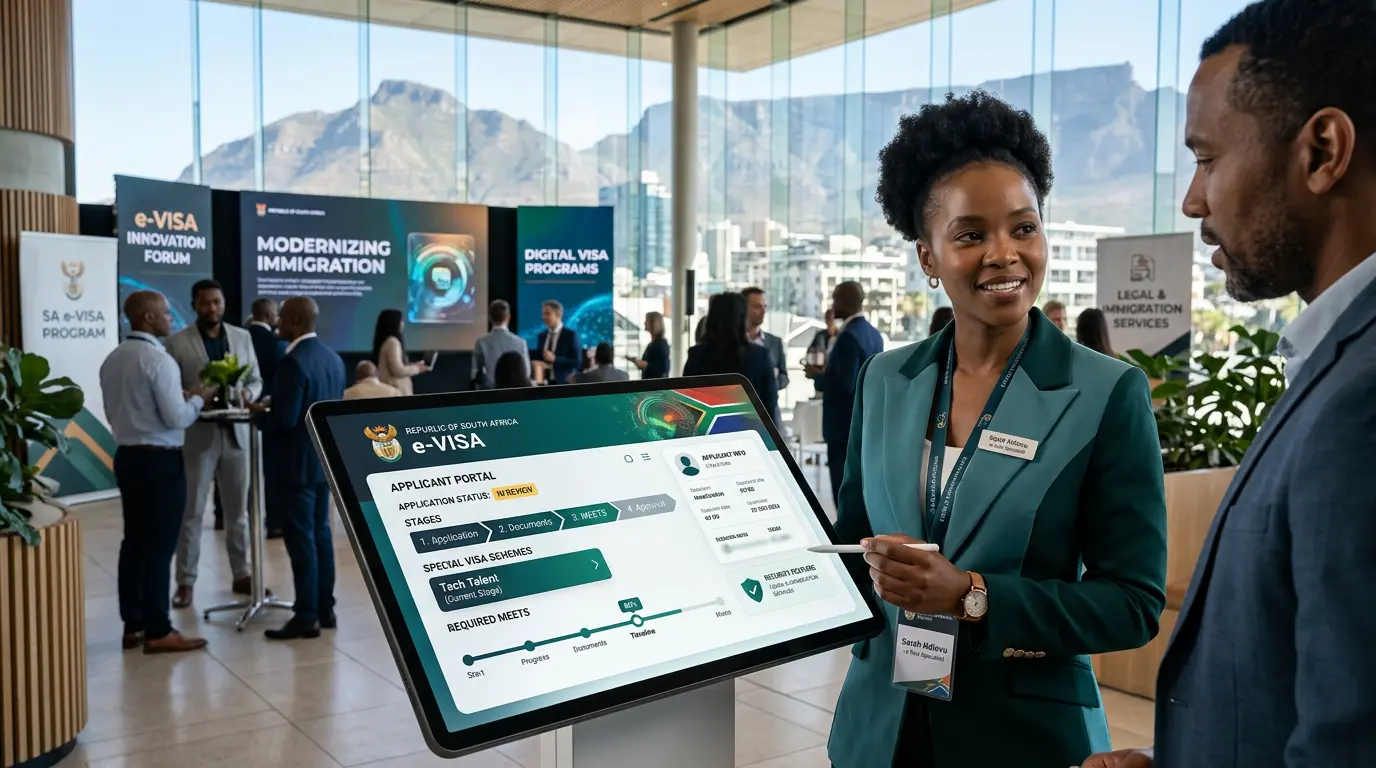
In 2025, the Department of Home Affairs (DHA) launched several innovative digital visa schemes designed to attract foreign talent and visitors in specific economic sectors. These schemes represent a **major paradigm shift** away from the traditional one-by-one, paper-based visa processing model toward sector-specific, fast-track, digital-first processing.
STAGES, MEETS, and Special Visa Schemes in South Africa
Overview
In 2025, the Department of Home Affairs (DHA) launched several innovative digital visa schemes designed to attract foreign talent and visitors in specific economic sectors. These schemes represent a major paradigm shift away from the traditional one-by-one, paper-based visa processing model toward sector-specific, fast-track, digital-first processing.
The key schemes include:
- STAGES (Screen Talent and Global Entertainment Scheme) for the film and television industry
- MEETS (Meetings, Events and Exhibitions Tourism Scheme) for the events and conferencing industry
- Electronic Travel Authorization (ETA) for pre-travel screening of short-term visitors
- eVisa System for digital visa applications from eligible nationalities
- Trusted Employer Scheme for pre-vetted corporate employers of foreign workers
These initiatives are grounded in the Immigration Act 13 of 2002, Ministerial directives, and DHA operational frameworks. They complement the broader Points-Based System (PBS) reforms introduced in October 2024 and align with the strategic direction outlined in the December 2025 Draft White Paper on Citizenship, Immigration, and Refugee Protection.
STAGES (Screen Talent and Global Entertainment Scheme)
Background and Launch
- Announced: July 2025 by the Minister of Home Affairs
- Operational: Q4 2025 (late 2025)
- Purpose: Attract international film and television production to South Africa by removing the visa bottleneck that was causing productions to choose other countries
How STAGES Works
- An international production company registers on the dedicated STAGES online portal.
- The production company submits a single batch application covering all foreign cast, crew, and production staff required for a specific production in South Africa.
- Applications are processed through an expedited digital adjudication pathway.
- Visa outcomes are issued within hours, not weeks or months.
- Approved personnel receive digital visa authorisation linked to the specific production.
Eligibility
- International film and television production companies with a confirmed production in South Africa
- Foreign cast members (actors, presenters, voice artists)
- Foreign crew (directors, cinematographers, sound engineers, editors, grips, etc.)
- Post-production and visual effects teams working on-site in SA
- Production management and support staff
- The application must be for a specific, identified production taking place in South Africa
Key Benefits
| Benefit | Detail |
|---|---|
| Speed | Visa outcomes in hours instead of weeks/months |
| Batch processing | Single application for entire production team |
| Digital application | Fully online portal; no VFS appointments needed per individual |
| Reduced bureaucracy | Streamlined documentation requirements |
| Port-of-entry biometrics | Biometrics captured on arrival, not at an embassy/VFS beforehand |
South African Film Industry Context
South Africa, and Cape Town in particular, is one of the world's premier filming destinations, offering diverse landscapes, world-class production facilities, competitive costs, and a skilled local crew base. The industry contributes significantly to GDP and employment. However, South Africa competes directly with:
- Morocco (streamlined crew visa process, tax incentives)
- United Kingdom (established infrastructure, tax credits)
- Australia (location diversity, government incentives)
- Eastern Europe (Hungary, Czech Republic -- cost-competitive, EU access)
Prior to STAGES, the slow and unpredictable SA visa process was a major competitive disadvantage. Productions with tight schedules and large international crews (sometimes 50-200+ foreign personnel) could not afford weeks of uncertainty. STAGES directly addresses this by guaranteeing rapid turnaround.
South Africa also offers a film incentive rebate of 20-25% on qualifying production expenditure, which, combined with STAGES, creates a compelling package for international productions.
Current Status
STAGES is operational and actively processing applications as of early 2026. Several international productions have utilised the scheme successfully.
MEETS (Meetings, Events and Exhibitions Tourism Scheme)
Background and Launch
- Launched: 2025 (alongside STAGES)
- Purpose: Attract international events, conferences, exhibitions, sporting events, and entertainment productions to South Africa by streamlining visa processing for event participants
How MEETS Works
- An event organiser or promoter applies through the dedicated MEETS online portal.
- The organiser submits a batch application covering all foreign participants, speakers, performers, exhibitors, and support staff.
- Applications are processed through fast-track digital adjudication.
- Visa outcomes are issued within days (significantly faster than standard processing).
- Biometrics are captured at the port of entry upon arrival.
Qualifying Events
MEETS covers a broad range of event types:
- International conferences and conventions (academic, industry, governmental)
- Music festivals and concerts (touring artists, festival lineups)
- Sporting events (SA20 cricket league, rugby sevens, marathons, golf tournaments, motorsport)
- Exhibitions and trade shows (Africa's Big Seven, Mining Indaba, SAITEX)
- Theatre and performing arts (touring productions, dance companies, orchestras)
- Award ceremonies (regional and international)
- Corporate events (product launches, incentive travel groups)
Key Benefits
| Benefit | Detail |
|---|---|
| Speed | Processing in days, not weeks |
| Batch processing | Single application for all event participants |
| Digital application | Fully online; no individual VFS appointments |
| Event economy support | Removes visa barriers to international participation |
| Port-of-entry biometrics | No pre-arrival biometrics required |
South African Events Industry Context
South Africa is Africa's leading events and conference destination and competes internationally with the UAE (Dubai), Singapore, and Kenya (Nairobi) for the African and emerging-market conference circuit. Events tourism contributes substantially to GDP, employment, and foreign exchange earnings.
Prior to MEETS, visa barriers were a significant obstacle. International conference organisers reported that delegates from visa-required countries frequently could not attend because their visas were not processed in time. This undermined South Africa's competitiveness and caused economic losses estimated in the billions of rands annually.
MEETS directly addresses this by enabling event organisers to secure visas for their participants in bulk and on an accelerated timeline.
Electronic Travel Authorization (ETA)
Phased Rollout
- Phase 1 (October 2025): Nationals of G20 countries -- applies to tourism and short business visits
- Phase 2 (February 2026): Nationals of China, India, Indonesia, and Mexico added
VisaFlow
Want to automate your visa workflow?
Join hundreds of South African immigration firms using VisaFlow to manage cases, documents, and clients.
Learn more →How the ETA Works
- The traveller applies online through the DHA ETA portal before travelling to South Africa.
- The application requires: biographic data, travel document (passport) scan, digital photograph, and basic travel information.
- Applications undergo AI-assisted processing for risk assessment and verification.
- Target turnaround: 24 hours from submission.
- Approval is linked electronically to the passport -- there is no physical visa label or sticker.
- The traveller presents their passport at the South African port of entry, where the electronic authorisation is verified.
Where the ETA Is Currently Operational
- OR Tambo International Airport (JNB), Johannesburg
- Cape Town International Airport (CPT)
- Lanseria International Airport (HLA)
Planned Expansion
The ETA system is planned for expansion to:
- All remaining international airports
- The busiest land border posts (Beitbridge, Lebombo, Maseru Bridge, etc.)
Not yet available at: Other airports, seaports, or smaller land border crossings.
Duration of Stay
- Typically authorises a stay of 30-90 days depending on the applicant's nationality and the bilateral agreements in place.
- The ETA is for short-term visits only (tourism, short business trips, transit).
ETA vs. eVisa: Key Distinction
| Feature | ETA | eVisa |
|---|---|---|
| Nature | Pre-travel authorisation (similar to US ESTA or EU ETIAS) | Full visa issued electronically |
| Purpose | Screening and pre-clearance | Complete visa adjudication |
| Processing | Largely automated / AI-assisted | Human adjudication (digitally) |
| Complexity | Simple form, minimal documents | Full visa application with supporting documents |
| Target users | Nationals of countries with generally low visa risk | Nationals who require full visas |
Cost
Cost information is pending final publication by DHA but is expected to be a nominal administrative fee.
eVisa System -- Current Status
Purpose
The eVisa system allows foreign nationals from eligible countries to apply for and receive a full visa electronically, without visiting a VFS Global office or South African embassy/consulate.
Availability
- Available for 20+ nationalities for tourism and business visa categories as of 2026.
- 20+ additional nationalities were added during 2025.
- Currently available only for short-term visas (tourism visitor visas and business visitor visas).
- NOT available for: Work visas, study visas, relative's visas, retirement visas, or permanent residency applications.
How to Apply
- Apply through the DHA ePermits portal: https://ePermit.homeaffairs.gov.za
- Complete the online application form and upload supporting documents (passport, proof of accommodation, return flight, proof of funds, etc.).
- Application undergoes digital adjudication by DHA officials.
- Approved applicants receive an electronic visa notification.
- Biometrics are captured at the port of entry upon arrival in South Africa.
Processing Time
Processing times vary but are generally days to a few weeks, significantly faster than traditional paper-based VFS applications for the same visa categories.
Comparison of Fast-Track Schemes
| Feature | STAGES | MEETS | ETA | eVisa |
|---|---|---|---|---|
| Processing time | Hours | Days | 24 hours (target) | Days to weeks |
| Application type | Batch (by production company) | Batch (by event organiser) | Individual | Individual |
| Portal | Dedicated STAGES portal | Dedicated MEETS portal | DHA ETA portal | DHA ePermits portal |
| Visa types covered | Work/visitor (production-specific) | Visitor (event-specific) | Pre-travel authorisation | Tourism / business visitor |
| Biometrics | At port of entry | At port of entry | At port of entry | At port of entry |
| Currently operational | Yes | Yes | Phased rollout (Phase 1 & 2 live) | Yes (20+ countries) |
| Who initiates | Production company | Event organiser | Individual traveller | Individual traveller |
Trusted Employer Scheme
Background
The Trusted Employer Scheme was announced at the 2023 Investment Summit by President Ramaphosa as part of a package of reforms to make South Africa more competitive for foreign investment and skilled talent.
Purpose
To pre-vet employers so that work visa applications submitted by trusted employers receive simplified requirements and expedited processing. The scheme recognises that established, compliant employers pose lower immigration risk and should benefit from a streamlined process.
Benefits for Trusted Employers
| Benefit | Detail |
|---|---|
| Points bonus | 30 bonus points under the PBS (significant advantage toward the 100-point threshold) |
| Faster processing | Target: 4 weeks for critical skills visa applications |
| Simplified documentation | Reduced documentary requirements for visa applications |
| Dedicated processing queue | Applications routed to a priority adjudication track |
| Waiver of certain requirements | Some standard requirements may be waived or relaxed |
Requirements to Qualify
An employer must demonstrate:
- Minimum 5 years of operational history in South Africa
- Clean compliance record with DHA (no immigration violations)
- No history of immigration violations (employing illegal foreigners, document fraud, etc.)
- Commitment to annual compliance audits by DHA
- Good standing with SARS (tax), Department of Employment and Labour (DEL), and CIPC (company registration)
Membership Details
- Duration: 5 years, renewable upon re-assessment
- Status: Limited rollout during 2025/2026 with full implementation expected by 2027
- Application: Through DHA directly (the formal application process is still being finalised and refined)
White Paper Endorsement
The December 2025 Draft White Paper on Citizenship, Immigration, and Refugee Protection explicitly endorses the Trusted Employer Scheme and proposes its expansion. The White Paper envisions the scheme as a cornerstone of the reformed work visa system, with graduated trust levels and sector-specific adaptations.
Proposed New Visa Categories (White Paper 2025)
The December 2025 Draft White Paper proposes several new or restructured visa categories. While these are not yet law and remain subject to public comment and parliamentary process, immigration practitioners should be aware of the direction of reform:
Skilled Worker Visa
- Replaces: Both the Critical Skills Visa and General Work Visa
- Mechanism: Single points-based route for all skilled foreign workers
- Key change: Eliminates the distinction between "critical skills" and "general work"; all assessed on a unified points scale
Start-Up Visa
- Purpose: Standalone visa category for innovative entrepreneurs
- Key feature: Endorsement by an approved incubator or accelerator programme
- Distinction from current business visa: Lower capital requirement, focus on innovation and job creation potential rather than established capital
Investment Visa
- Replaces: Current business visa (in part)
- Mechanism: Periodic capital thresholds (adjusted for inflation), economic impact assessment
- Focus: Attracting high-value foreign direct investment
Sports and Arts Visa
- Purpose: Dedicated immigration route for athletes, performing artists, and cultural workers
- Distinction: Separate from the general work visa, recognising the unique nature of sports and arts employment (seasonal, event-based, touring)
Sectoral Work Visa
- Replaces: Corporate visa (Section 21 of the Immigration Act)
- Mechanism: Industry-specific quotas set by the Minister in consultation with sector bodies
- Purpose: Allow employers in specific sectors to recruit foreign workers within pre-approved quotas
Enhanced Remote Work Visa
- Builds on: Current Section 11A remote work/digital nomad visa
- Enhancements: Expanded eligibility, longer duration, clearer pathway provisions
Family Visa Enhancements
- Key change: Work and business authorisation for family visa holders (spouses, children, dependants)
- Purpose: Enable accompanying family members to contribute economically during their stay
Student-to-Skilled-Worker Transition
- Purpose: Streamlined pathway from study visa to employment visa
- Key feature: South African-educated foreign graduates can transition to a work visa without returning to their home country, with simplified requirements recognising their SA qualification
KEY SOURCES
- Department of Home Affairs (DHA) - Official announcements on STAGES and MEETS: https://www.dha.gov.za
- DHA ePermits Portal - eVisa applications: https://ePermit.homeaffairs.gov.za
- DHA Media Statements 2025 - Ministerial announcements on STAGES, MEETS, and ETA rollout
- Immigration Act 13 of 2002 (as amended): https://www.gov.za/documents/immigration-act
- Draft White Paper on Citizenship, Immigration, and Refugee Protection (December 2025) - Government Gazette No. 52034
- President Ramaphosa's 2023 Investment Summit Address - Trusted Employer Scheme announcement
- National Film and Video Foundation (NFVF) - SA film industry data: https://www.nfvf.co.za
- South African Tourism - Events and conferencing statistics: https://www.southafrica.net
- DTI/DTIC Film Incentive Programme - Production rebate details: https://www.thedtic.gov.za
- Points-Based System Regulations (October 2024) - Government Gazette No. 51469
- VFS Global South Africa - Visa application services: https://visa.vfsglobal.com/zaf/en/zaf