
Key Takeaway
Children travelling to, from, or within South Africa are subject to specific immigration requirements designed to prevent child trafficking, ensure parental consent, and protect the best interests of the child. The framework involves the Immigration Act, the Children's Act, the Births and Deaths Registration Act, and international instruments such as the Hague Convention. Requirements were significantly relaxed in November 2019, but core safeguards remain in place. Immigration practitioners must understand the interplay between these instruments when advising families, employers sponsoring dependant visas, and educational institutions hosting foreign students.
Minors & Child Immigration - South Africa
Overview
Children travelling to, from, or within South Africa are subject to specific immigration requirements designed to prevent child trafficking, ensure parental consent, and protect the best interests of the child. The framework involves the Immigration Act, the Children's Act, the Births and Deaths Registration Act, and international instruments such as the Hague Convention. Requirements were significantly relaxed in November 2019, but core safeguards remain in place. Immigration practitioners must understand the interplay between these instruments when advising families, employers sponsoring dependant visas, and educational institutions hosting foreign students.
Unabridged Birth Certificate (UBC)
Requirement
- An Unabridged Birth Certificate is required for all children under 18 travelling internationally or applying for visas in South Africa
- The UBC must reflect the details of both parents (full names, identity numbers or passport numbers)
- A certified copy of the UBC is acceptable in most circumstances
- Foreign equivalents of the UBC are accepted provided they are accompanied by a sworn English translation by a certified translator
Distinction from Abridged Certificate
- The abridged birth certificate (the standard computer-generated certificate) shows only the child's details and one parent
- The unabridged certificate is the full-form version reflecting both parents and is the version required for immigration purposes
- South African UBCs are obtained from the Department of Home Affairs; processing time is typically 8-12 weeks
Purpose
- The UBC requirement is fundamentally an anti-trafficking measure
- It allows immigration officers to verify the identity of accompanying adults and confirm their relationship to the child
- It deters the movement of children by persons who do not have parental authority
November 2019 Relaxation
Background
In November 2019, the Minister of Home Affairs announced a relaxation of the stringent child travel document requirements that had been in place since 2015. The original requirements had drawn significant criticism from the tourism industry and led to families being denied boarding or entry.
Key Changes
| Category | Before November 2019 | After November 2019 |
|---|---|---|
| Visa-exempt country children at ports of entry | UBC mandatory | Valid passport only (UBC no longer mandatory at ports) |
| SA children on SA passport | UBC required separately | SA passport sufficient (no separate birth certificate needed) |
| School tours | Individual parental consent per child | Principal's letter replaces individual consent for organised school tours |
What Remains Unchanged
- UBC is still required for visa applications (including study visas, relative's visas, and dependant endorsements)
- Parental consent affidavits are still required when a child travels with one parent or without parents
- Immigration officers retain the discretion to request additional documentation if trafficking is suspected
Parental Consent Affidavit
When One Parent Travels with the Child
The accompanying parent must carry:
- Consent affidavit from the absent parent, authorising the travel
- The affidavit must be dated within 6 months of the travel date
- Certified copy of the absent parent's ID (passport or national identity document)
- Contact details of the absent parent (phone number and/or email address)
When Both Parents Are Absent
The accompanying adult must carry:
- Consent affidavits from both parents, authorising the travel with the named adult
- Certified copies of both parents' IDs
- Letter from the person receiving the child at the destination (if applicable)
- Proof of the relationship or authority of the accompanying adult
Format
- The affidavit must be sworn before a Commissioner of Oaths, notary public, or equivalent authority in the country of origin
- Must be in English or accompanied by a sworn translation
- Must identify the child by name and date of birth
- Must specify the travel dates and destination
Court Orders and Parental Responsibilities
Full Parental Responsibilities
- Where one parent has been granted full parental responsibilities and rights by a court order, the consent of the other parent is not required
- The parent must carry a certified copy of the court order when travelling
Shared Parental Responsibilities
- Where parents have shared parental responsibilities (joint custody), the consent of the non-travelling parent is still required
- A court order for shared responsibilities does not waive the consent requirement
Death of a Parent
- If one parent is deceased, the surviving parent must carry:
- The death certificate of the deceased parent
- The child's unabridged birth certificate
- No consent affidavit is required from the deceased parent
Study Visa for Minors (Section 13)
Standard Requirements
All standard study visa requirements apply to minors, including:
- Acceptance letter from a recognised South African educational institution
- Proof of sufficient financial means or a financial guarantee
- Medical and radiological reports
- Valid passport with at least 30 days' validity beyond the intended stay
Additional Requirements for Minors
| Requirement | Detail |
|---|---|
| Parental consent | Consent from both parents (sworn affidavits), regardless of which parent applies |
| Unabridged birth certificate | UBC or foreign equivalent with sworn translation |
| Guardianship arrangement | Required if parents will not be residing in South Africa |
| Vaccination certificates | As prescribed by the Department of Health |
Guardianship Arrangement (Parents Not in SA)
Where the minor will reside in South Africa without their parents, the following must be submitted:
- Guardian's letter of undertaking - the appointed guardian accepts responsibility for the child's welfare, accommodation, and compliance with visa conditions
- Proof of the guardian's residential address in South Africa
- Certified copy of the guardian's South African ID or permanent residence permit
- The guardian must be a person of suitable character; DHA may require a police clearance certificate
Relative's Visa for Children (Section 18)
Purpose
A relative's visa allows a foreign child to reside in South Africa as a dependant of a South African citizen, permanent resident, or work visa holder.
VisaFlow
Want to automate your visa workflow?
Join hundreds of South African immigration firms using VisaFlow to manage cases, documents, and clients.
Learn more →Requirements
- Unabridged birth certificate proving the relationship between the child and the sponsoring relative
- Proof of the relative's immigration status (SA ID, permanent residence certificate, or valid work visa)
- Proof of financial means to support the child
Financial Requirements
| Applicant Category | Financial Requirement |
|---|---|
| General relative's visa | R8,500 per month maintenance requirement |
| Dependent minor of SA citizen | Maintenance requirement waived |
| Dependent child of SA citizen or PR | Visa issued free of charge |
Section 26(c) Permanent Residency for Children Under 21
Eligibility
- The child must be under 21 years of age
- The child must be a dependant of a South African citizen or permanent resident
Application Requirements
- DHA-947 form (Application for Permanent Residence)
- Consent of both parents (sworn affidavits)
- Unabridged birth certificate proving parent-child relationship
- Proof of dependency - evidence that the child is financially dependent on the SA citizen/PR parent
- Proof of the parent's SA citizenship or permanent residence status
- Medical and radiological reports for the child
Processing Time
- 12-18 months from submission to outcome
- Applications are processed at DHA head office in Pretoria
Unaccompanied Minors
Immigration Requirements - Regulation 6(12)(d)
- An unaccompanied minor must present consent letters from both parents authorising the travel
- The consent letters must identify the person who will receive the child in South Africa
- Additional scrutiny is applied at ports of entry
Children's Act Protections - Section 150
- A child found to be without appropriate care is deemed a child in need of care and protection under Section 150 of the Children's Act 38 of 2005
- This triggers mandatory intervention by child protection services
Process
- Immigration officers identify the unaccompanied minor at the port of entry
- If documentation is inadequate, the Children's Court is involved
- A social worker is assigned to assess the child's circumstances
- The court may order that the child be placed in temporary safe care
- The Department of Social Development (DSD) coordinates with DHA and the child's country of origin
Child Trafficking Safeguards
PACOTIP Act (Prevention and Combating of Trafficking in Persons Act 7 of 2013)
| Aspect | Detail |
|---|---|
| Maximum penalty for trafficking | Life imprisonment |
| Maximum fine | R100 million |
| Scope | Applies to South African citizens and foreign nationals, within and across borders |
| Specific child provisions | Enhanced penalties where the victim is a child |
UBC as Anti-Trafficking Measure
- The requirement for an unabridged birth certificate at visa application stage is explicitly an anti-trafficking safeguard
- It establishes the identity of both parents and enables verification of the adult's relationship to the child
- Immigration officers are trained to verify the authority of adults travelling with children
Screening at Ports of Entry
- Immigration officers are trained to screen for trafficking indicators, including:
- Child appears fearful, anxious, or unable to communicate freely
- Adult cannot provide documentation proving relationship to the child
- Travel itinerary or circumstances appear inconsistent
- Child has no luggage or personal belongings
- Signs of physical abuse or neglect
South Africa's International Standing
- South Africa is on the Tier 2 Watch List in the US State Department's 2024 Trafficking in Persons (TIP) Report
- This ranking indicates that SA does not fully meet the minimum standards for the elimination of trafficking but is making significant efforts to do so
- The ranking creates pressure for continued strengthening of child protection measures at borders
Birth Registration for Children of Foreign Parents
Legal Framework
- Governed by the Births and Deaths Registration Act 51 of 1992
- All births occurring in South Africa must be registered, regardless of the parents' nationality
Registration Process
- Must be registered within 30 days of birth at a DHA office or hospital registration point
- Required documents: hospital notification of birth, parents' passports, parents' visas or permits, marriage certificate (if applicable)
Citizenship Status of Children Born to Foreign Parents
| Scenario | Citizenship Outcome |
|---|---|
| Both parents are foreign nationals | No automatic SA citizenship - child takes parents' nationality |
| SA ID number | Not issued to children of foreign parents (unless one parent is SA citizen) |
| Section 4(3) Citizenship Act | Child may apply for citizenship at age 18 if they have lived in SA continuously since birth |
| Section 2(2) - Stateless children | A child born in SA who would otherwise be stateless is entitled to SA citizenship by birth |
Practical Implications
- Children born to foreign parents in SA receive a birth certificate but not an SA ID number
- The child's nationality is determined by the parents' country of citizenship and that country's nationality laws
- Parents should register the birth with their own country's embassy or consulate in addition to DHA
Refugee Children's Rights
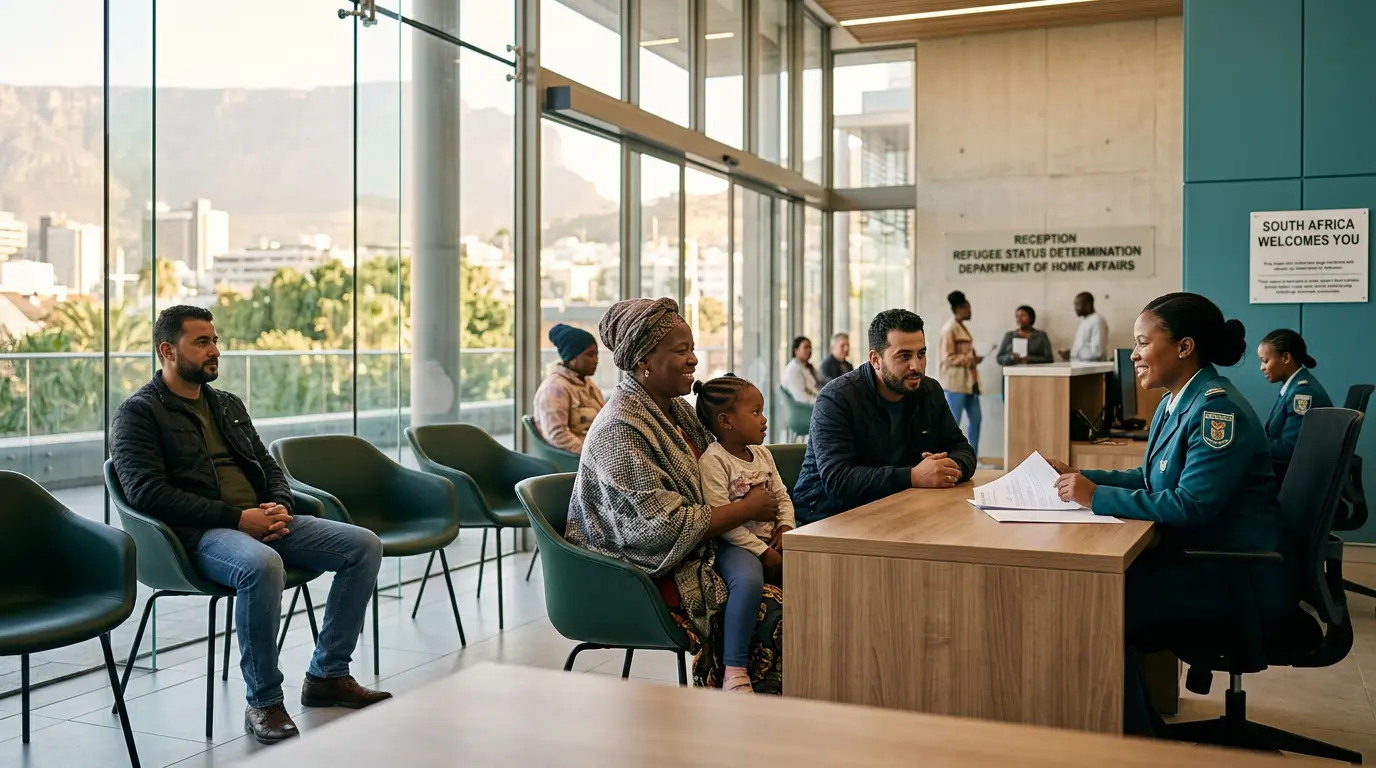
Inclusion in Asylum Claims
- Dependent children are included in their parent's asylum seeker or refugee status application
- The child does not need to submit a separate application
- The child's status is linked to the parent's status and expires or is renewed with the parent's permit
Rights of Refugee Children in South Africa
| Right | Legal Basis | Detail |
|---|---|---|
| Basic education | Constitution Section 29, Refugees Act | Same as SA citizens - refugee children have the right to attend public schools |
| Basic healthcare | Constitution Section 27, Refugees Act | Access to primary healthcare services at public facilities |
| Children's Act protections | Children's Act 38 of 2005 | All protections under the Children's Act apply to refugee children, including protection from abuse, neglect, and exploitation |
| Social assistance | Social Assistance Act | Limited access; refugee children may qualify for certain grants through foster care arrangements |
| Birth registration | Births and Deaths Registration Act | Children born to refugees in SA must be registered |
Unaccompanied Refugee Minors
- Treated as children in need of care and protection under Section 150 of the Children's Act
- Entitled to a social worker and placement in temporary safe care
- The Refugee Reception Office must process their asylum claim with special consideration for their vulnerability
Adoption of Foreign Children / International Adoption
Hague Convention
- South Africa has been a party to the Hague Convention on Intercountry Adoption since 2003
- The Convention provides a framework for international adoptions that prioritises the best interests of the child and prevents trafficking
Domestic Legislation
- International adoptions are governed by Chapter 16 of the Children's Act 38 of 2005
- The Department of Social Development (DSD) serves as the Central Authority for Hague Convention matters
Subsidiarity Principle
- Domestic adoption is prioritised over intercountry adoption
- An intercountry adoption may only be considered after all reasonable efforts to place the child domestically have been exhausted
- The Children's Court must be satisfied that domestic placement is not feasible before approving an intercountry adoption
Process for Intercountry Adoption
- Prospective adoptive parents apply through an accredited adoption agency in their country of residence
- The Central Authority in the receiving country transmits the application to DSD in South Africa
- DSD assesses the application and matches the child with the prospective parents
- A social worker compiles a report for the Children's Court
- The Children's Court issues an adoption order
- DSD issues a compliance certificate under the Hague Convention
- The child's immigration status is processed by DHA (typically a relative's visa initially, followed by permanent residence)
Requirements for Prospective Adoptive Parents
- Must be assessed as suitable by an accredited adoption agency
- Must meet the requirements of both South African law and the law of their country of residence
- Must reside in a country that is a party to the Hague Convention (for Convention adoptions)
- The child must have been declared adoptable by a Children's Court
Sources
- Immigration Act 13 of 2002, Sections 13, 18, 26: https://www.gov.za/documents/immigration-act
- Immigration Regulations, Regulation 6(12): https://www.dha.gov.za/
- Children's Act 38 of 2005: https://www.gov.za/documents/childrens-act
- Prevention and Combating of Trafficking in Persons Act 7 of 2013 (PACOTIP): https://www.gov.za/documents/prevention-and-combating-trafficking-persons-act
- Births and Deaths Registration Act 51 of 1992: https://www.gov.za/documents/births-and-deaths-registration-act
- South African Citizenship Act 88 of 1995, Sections 2(2) and 4(3): https://www.gov.za/documents/south-african-citizenship-act
- Refugees Act 130 of 1998: https://www.gov.za/documents/refugees-act
- Hague Convention on Intercountry Adoption: https://www.hcch.net/en/instruments/conventions/full-text/?cid=69
- DHA November 2019 travel requirements relaxation: https://www.dha.gov.za/
- US State Department Trafficking in Persons Report (2024): https://www.state.gov/trafficking-in-persons-report/