
Key Takeaway
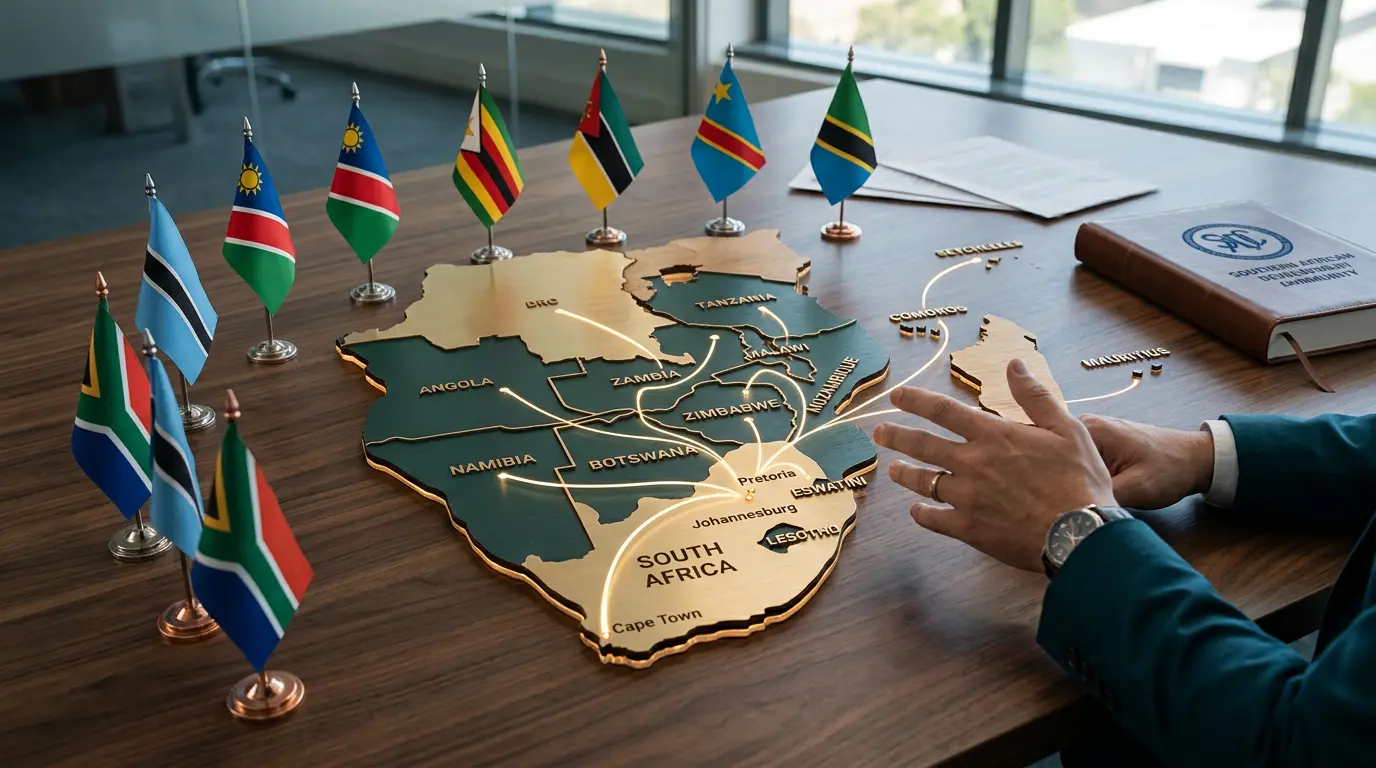
South Africa's immigration framework is shaped not only by domestic legislation but also by regional and bilateral agreements that govern the movement of persons. The Southern African Development Community (SADC) Protocol on the Facilitation of Movement of Persons provides a regional framework, while a network of bilateral visa waiver agreements and cross-border arrangements determines the specific terms of entry for nationals of various countries. Additionally, BRICS mobility arrangements and special diplomatic exemptions add further layers to the system.
SADC & Bilateral Immigration Agreements - South Africa
Overview
South Africa's immigration framework is shaped not only by domestic legislation but also by regional and bilateral agreements that govern the movement of persons. The Southern African Development Community (SADC) Protocol on the Facilitation of Movement of Persons provides a regional framework, while a network of bilateral visa waiver agreements and cross-border arrangements determines the specific terms of entry for nationals of various countries. Additionally, BRICS mobility arrangements and special diplomatic exemptions add further layers to the system.
Key instruments:
- SADC Protocol on Facilitation of Movement of Persons (2005)
- Bilateral visa waiver agreements (published via Government Gazette notices)
- Immigration Act 13 of 2002, Section 7 (Minister's powers to declare visa exemptions)
- BRICS cooperation agreements on mobility
SADC PROTOCOL ON FACILITATION OF MOVEMENT OF PERSONS
Background
The SADC Protocol on the Facilitation of Movement of Persons was adopted on 18 August 2005 at the SADC Summit in Gaborone, Botswana. It aims to progressively facilitate the movement of citizens of SADC member states within the region by eliminating obstacles to free movement.
Key Provisions
The Protocol provides for three phases of movement facilitation:
| Phase | Right | Description |
|---|---|---|
| Phase 1 | Visa-free entry | Citizens may enter another member state for up to 90 days without a visa for lawful purposes |
| Phase 2 | Temporary residence | Citizens may apply for residence to engage in lawful economic activity, education, or training |
| Phase 3 | Permanent residence | Citizens may apply for permanent residence after a qualifying period of legal residence |
Ratification Status
The Protocol requires ratification by 11 of 16 SADC member states to enter into force. As of February 2026:
| Member State | Status |
|---|---|
| Botswana | Ratified |
| Lesotho | Ratified |
| Mozambique | Ratified |
| South Africa | Signed and ratified |
| Eswatini | Ratified |
| Zambia | Ratified |
| Angola | Not ratified |
| DRC | Not ratified |
| Comoros | Not ratified |
| Madagascar | Not ratified |
| Malawi | Not ratified |
| Mauritius | Not ratified |
| Namibia | Not ratified |
| Seychelles | Not ratified |
| Tanzania | Not ratified |
| Zimbabwe | Not ratified |
Status: NOT yet in force - Only 6 of the required 11 member states have ratified.
Why the Protocol Has Stalled
- Security concerns among member states regarding uncontrolled migration
- Economic disparities between member states creating pull factors toward wealthier countries (primarily South Africa)
- Lack of harmonised border management systems across the region
- National sovereignty concerns over immigration policy
- Fears of labour market displacement in destination countries
- Insufficient infrastructure at border posts to manage increased movement
- Political instability in certain member states
SOUTH AFRICA'S POSITION ON REGIONAL MOVEMENT
Policy Stance
South Africa has signed and ratified the SADC Protocol but maintains a preference for bilateral agreements over blanket regional free movement:
- Bilateral approach: SA negotiates specific terms with individual countries, allowing it to control visa-free periods, conditions, and reciprocity
- Security concerns: SA has consistently cited concerns about irregular migration, cross-border crime, and border security as reasons for caution on regional free movement
- Economic considerations: With the largest and most diversified economy in the SADC region, SA attracts significant migration flows and is cautious about open borders
- Managed migration: The White Paper on Citizenship, Immigration and Refugee Protection (2024) emphasises managed migration over open borders, with enhanced biometric controls and digital systems
Practical Effect
Despite not fully implementing the SADC Protocol, South Africa has achieved de facto visa-free entry with most SADC member states through bilateral agreements, typically granting 30 or 90 days visa-free entry for short visits.
BILATERAL VISA WAIVER AGREEMENTS
90-Day Visa Exemption Countries
Citizens of the following countries may enter South Africa for up to 90 days without a visa:
Europe
- Andorra, Austria, Belgium, Bulgaria (added August 2025), Croatia (added August 2025), Czech Republic, Denmark, Estonia (added August 2025), Finland, France, Germany, Greece, Hungary (added August 2025), Iceland, Ireland, Italy, Latvia (added August 2025), Liechtenstein, Lithuania (added August 2025), Luxembourg, Malta, Monaco, Netherlands, Norway, Portugal, Romania (added August 2025), Slovakia (added August 2025), Slovenia (added August 2025), Spain, Sweden, Switzerland, United Kingdom
Americas
- Argentina, Brazil, Canada, Chile, Ecuador, Panama, Paraguay, United States of America, Uruguay, Venezuela
Asia-Pacific
- Australia, Japan, New Zealand, Singapore, South Korea, Thailand
Middle East
- Israel, Turkey
Africa (90 days)
- Benin, Botswana, Cape Verde, Ghana, Kenya, Namibia, Rwanda, Seychelles, Tanzania, Zambia, Zimbabwe
30-Day Visa Exemption Countries
Citizens of the following countries may enter South Africa for up to 30 days without a visa:
Africa (30 days)
- Eswatini (Swaziland)
- Lesotho
- Malawi
- Mauritius
- Mozambique
Other (30 days)
- Hong Kong SAR (HKSAR passport holders)
- Jamaica
August 2025 Additions
In August 2025, the Minister of Home Affairs gazetted visa waivers for citizens of nine additional countries, all EU member states:
VisaFlow
Want to automate your visa workflow?
Join hundreds of South African immigration firms using VisaFlow to manage cases, documents, and clients.
Learn more →| Country | Exemption Period | Effective |
|---|---|---|
| Bulgaria | 90 days | August 2025 |
| Lithuania | 90 days | August 2025 |
| Slovakia | 90 days | August 2025 |
| Hungary | 90 days | August 2025 |
| Slovenia | 90 days | August 2025 |
| Romania | 90 days | August 2025 |
| Latvia | 90 days | August 2025 |
| Estonia | 90 days | August 2025 |
| Croatia | 90 days | August 2025 |
These additions were part of the Government of National Unity's (GNU) strategy to boost tourism and foreign direct investment by aligning South Africa's visa waiver list more closely with the full EU membership.
CROSS-BORDER ARRANGEMENTS BY COUNTRY
Zimbabwe - Beitbridge Border Post
| Feature | Detail |
|---|---|
| Border post | Beitbridge (South Africa) / Beitbridge (Zimbabwe) |
| Operating hours | 24 hours |
| Volume | Largest land border crossing in Southern Africa by volume |
| Location | Limpopo Province, across the Limpopo River |
| Key features | Processes thousands of travellers daily; major commercial corridor |
| Special permits | Zimbabwean Exemption Permit (ZEP) holders may cross freely |
| Challenges | Chronic congestion, long queues (especially during festive season), infrastructure under strain |
| Upgrades | Multi-billion Rand upgrade project underway to increase capacity and introduce OSBP (One-Stop Border Post) |
| Visa-free | Zimbabwean nationals: 90 days visa-free |
Mozambique - Lebombo/Ressano Garcia Border Post
| Feature | Detail |
|---|---|
| Border post | Lebombo (South Africa) / Ressano Garcia (Mozambique) |
| Operating hours | 06:00 - 24:00 |
| Location | Mpumalanga Province, along the Maputo Corridor (N4 highway) |
| Key features | Part of the Maputo Development Corridor; One-Stop Border Post (OSBP) pilot |
| Volume | Second-busiest land border; significant commercial traffic |
| Special permits | Mozambican nationals: 30 days visa-free |
| Corridor | Maputo Corridor links Gauteng industrial heartland to the Port of Maputo |
| OSBP status | Operational as a pilot OSBP, reducing duplicate clearance procedures |
Lesotho - Multiple Border Posts
| Feature | Detail |
|---|---|
| Number of border posts | 13 (Lesotho is an enclave country entirely surrounded by SA) |
| Main border post | Maseru Bridge (24 hours) |
| Other key posts | Ficksburg Bridge, Caledonspoort, Van Rooyens Gate, Tele Bridge |
| Visa-free | Lesotho nationals: 30 days visa-free |
| Special permits | Lesotho Exemption Permit (LEP) for qualifying Lesotho nationals |
| Key features | High volume of daily cross-border commuters for work, trade, and medical services |
| Unique situation | Due to enclave geography, Lesotho nationals frequently transit through SA to travel between different parts of Lesotho |
Eswatini - Oshoek/Ngwenya Border Post
| Feature | Detail |
|---|---|
| Border post | Oshoek (South Africa) / Ngwenya (Eswatini) |
| Operating hours | 24 hours |
| Volume | Approximately 600 trucks daily; significant passenger traffic |
| Location | Mpumalanga Province |
| Visa-free | Eswatini nationals: 30 days visa-free |
| Key features | Major commercial route; connects to Mbabane and Manzini |
| Other border posts | Mahamba, Mananga, Josefsdal/Bulembu |
Botswana - Kopfontein/Tlokweng Border Post
| Feature | Detail |
|---|---|
| Border post | Kopfontein (South Africa) / Tlokweng (Botswana) |
| Location | North West Province, near Gaborone |
| Visa-free | Botswana nationals: 90 days visa-free |
| Key features | Proximity to Gaborone makes this a high-traffic crossing for business and personal travel |
| Other border posts | Skilpadshek/Pioneer Gate, Groblersbrug/Martin's Drift, Pont Drift, McCarthy's Rest |
Namibia - Vioolsdrif/Noordoewer Border Post
| Feature | Detail |
|---|---|
| Border post | Vioolsdrif (South Africa) / Noordoewer (Namibia) |
| Operating hours | 24 hours |
| Location | Northern Cape Province, across the Orange River |
| Visa-free | Namibian nationals: 90 days visa-free |
| Other border posts | Nakop/Ariamsvlei (also 24h, Trans-Kalahari Corridor) |
BRICS MOBILITY ARRANGEMENTS
10-Year Multiple-Entry Business Visa
Since December 2014, South Africa has participated in the BRICS Business Visa arrangement:
| Feature | Detail |
|---|---|
| Introduced | December 2014 |
| Eligible nationals | Russia, India, China (and reciprocally for SA nationals) |
| Visa type | 10-year multiple-entry business visa |
| Maximum stay per visit | 30 days |
| Processing time | 5 working days |
| Purpose | Business meetings, conferences, trade fairs, negotiations |
| Requirements | Valid passport, business invitation, proof of business activity, return ticket |
| Note | Does not permit employment or long-term residence |
BRICS Cooperation on Immigration
- BRICS nations have agreed in principle to further facilitate business travel and people-to-people exchanges
- Discussions on mutual recognition of certain professional qualifications are ongoing
- South Africa has proposed extending the business visa arrangement to include academic and research exchanges
- Brazil was added as the fifth BRICS nation with similar arrangements; newer BRICS members (Egypt, Ethiopia, Iran, UAE, Saudi Arabia, Indonesia) are in various stages of negotiation
ETA System and BRICS
- South Africa's Electronic Travel Authorisation (ETA) system, currently in phased rollout, is expected to eventually replace traditional visa sticker processes for many nationalities
- BRICS nationals from visa-requiring countries may benefit from streamlined ETA processing once the system is fully operational
- The ETA system is being developed in consultation with BRICS partners to ensure interoperability
SPECIAL EXEMPTIONS AND LAISSEZ-PASSER
SADC Laissez-Passer
- Issued to SADC officials and persons travelling on official SADC business
- Grants visa-free entry to all SADC member states for up to 90 days
- Recognised at all South African ports of entry
- Must be accompanied by a valid national passport
African Union (AU) Laissez-Passer
- Issued by the African Union Commission to AU officials and designated persons
- Grants visa-free entry to AU member states (including South Africa) for up to 90 days
- South Africa recognises the AU Laissez-Passer under its commitments to the AU
- Two categories: ordinary (90 days) and diplomatic (for senior AU officials)
United Nations Laissez-Passer (UNLP)
- Issued to UN officials and staff members
- Recognised by South Africa for official travel
- Grants visa-free entry for the duration of official business
- Blue cover (staff) and red cover (senior officials and diplomats)
Diplomatic and Official Passports
- Holders of diplomatic passports from many countries enjoy visa-free entry to SA under bilateral agreements
- Separate agreements may apply to holders of official/service passports
- These arrangements are distinct from ordinary passport visa waiver agreements
IMPLICATIONS FOR VISAFLOW
System Considerations
- Visa waiver lists must be kept current, especially following additions such as the August 2025 expansion
- The system should flag nationals who are visa-exempt to avoid unnecessary visa application processing
- Cross-border permit types (ZEP, LEP) require specific handling separate from standard visa categories
- BRICS business visa tracking should accommodate the 10-year validity and 30-day per-visit limits
- Border post information (operating hours, location) is relevant for travel advisory features
- SADC Protocol status should be monitored for changes in ratification that could trigger policy shifts
KEY SOURCES
- SADC Protocol on Facilitation of Movement of Persons (2005): https://www.sadc.int/document/protocol-facilitation-movement-persons-2005
- DHA - Visa Exemptions: https://www.dha.gov.za/index.php/immigration-services/exempt-countries
- Government Gazette - Visa Exemption Notices: https://www.gov.za/documents/government-gazette
- August 2025 Visa Waiver Expansion: Government Gazette notice under Section 7 of the Immigration Act
- White Paper on Citizenship, Immigration and Refugee Protection (2024): https://www.gov.za/documents/white-paper-citizenship-immigration-and-refugee-protection
- BRICS Business Visa Agreement: https://www.dha.gov.za
- Border Management Authority Act 2 of 2020: https://www.gov.za/documents/border-management-authority-act-2-2020
- SADC Website: https://www.sadc.int
- African Union - Free Movement Protocol: https://au.int/en/treaties/protocol-treaty-establishing-african-economic-community-relating-free-movement-persons
- Beitbridge Border Post Upgrade Project: https://www.dha.gov.za
- Maputo Corridor OSBP: https://www.mcli.co.za