
Key Takeaway
The primary legislation governing asylum and refugee protection in South Africa. It has been amended by the Refugees Amendment Act 11 of 2017.
Refugees & Asylum Seekers - South Africa
Legal Framework
Refugees Act 130 of 1998
The primary legislation governing asylum and refugee protection in South Africa. It has been amended by the Refugees Amendment Act 11 of 2017.
Full text: https://www.saflii.org/za/legis/consol_act/ra199899.pdf
Definition of a Refugee (Section 3)
A person qualifies for refugee status if they:
-
Persecution ground: Owing to a well-founded fear of being persecuted by reason of race, tribe, religion, nationality, political opinion or membership of a particular social group, is outside their country of nationality and is unable or unwilling to avail themselves of the protection of that country (aligns with UN 1951 Convention)
-
Generalized violence ground: Owing to external aggression, occupation, foreign domination or events seriously disturbing or disrupting public order in either a part or the whole of their country of origin (aligns with OAU Convention)
-
Dependant: Is a dependant of a person recognized as a refugee
The Asylum Process
Step 1: Entry into South Africa
- Asylum seekers must enter South Africa (legally or otherwise)
- Upon entry, they should declare their intention to seek asylum
- They are issued an Asylum Transit Visa (Section 23) to travel to a Refugee Reception Office
Step 2: Application at Refugee Reception Office
- Must apply in person at a Refugee Reception Office
- Complete Form BI-1590 (application for asylum)
- Provide reasons for seeking asylum
- Submit any supporting documentation
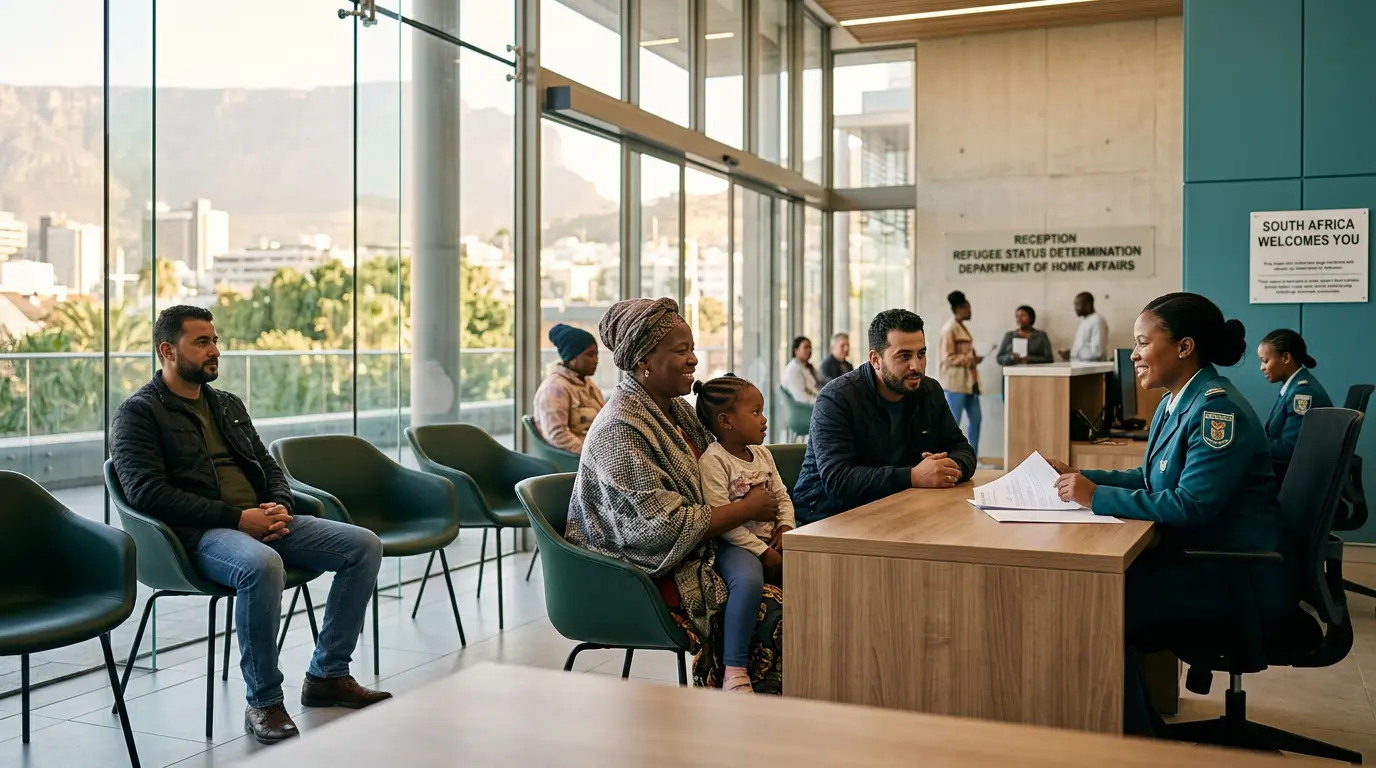
Refugee Reception Offices (RROs)
Current operational offices:
- Pretoria (Marabastad) - largest
- Durban (currently operating with limited capacity)
- Cape Town (Nyanga) - reopened after court orders
- Musina (Limpopo - near Zimbabwe border)
- Port Elizabeth (limited operations)
Note: Several RROs were closed in 2011-2012, leading to Constitutional Court challenges. Courts have ordered reopening of some offices.
Step 3: Section 22 Permit (Asylum Seeker Permit)
Upon applying:
- Applicant is issued a Section 22 permit (asylum seeker permit)
- Valid for up to 6 months initially
- Must be renewed at the RRO before expiry
- Legalizes the holder's stay in South Africa pending a decision
- Confers certain rights (work, study, etc.)
Step 4: Refugee Status Determination (RSD)
- A Refugee Status Determination Officer (RSDO) conducts an interview
- Assesses the claim against the legal criteria
- Three possible outcomes:
- Approval: Granted refugee status (Section 24 permit)
- Rejection: Claim denied
- Referral: Sent to Standing Committee for Refugee Affairs
Step 5: Appeals
- First appeal: To the Refugee Appeals Authority (RAA) - replaced the Refugee Appeal Board
- Must be lodged within 30 days of rejection
- Judicial review: To the High Court if administrative process is flawed
Rights of Asylum Seekers (Section 22 Permit Holders)
Constitutional Rights
Asylum seekers have all rights outlined in South Africa's Constitution Bill of Rights, EXCEPT:
- Right to vote
- Right to form a political party
- Rights explicitly reserved for South African citizens
Specific Rights
- Right to work: May seek employment (though employers often reluctant)
- Right to study: May enroll at educational institutions
- Right to healthcare: Access to public healthcare
- Freedom of movement: May settle anywhere in South Africa (no camps)
- Right to basic education: Children may attend school
- Right to documentation: Entitled to Section 22 permit
- Right to human dignity: Constitutional protection
- Right not to be refouled: Cannot be returned to a country where life/freedom is threatened
VisaFlow
Want to automate your visa workflow?
Join hundreds of South African immigration firms using VisaFlow to manage cases, documents, and clients.
Learn more →Limitations
- Cannot vote
- Cannot stand for public office
- May face practical barriers (employers not accepting Section 22 permits)
- Permit must be renewed regularly (every 6 months)
- Must appear at RRO for renewals and hearings
Rights of Recognized Refugees (Section 24 Permit Holders)
Section 24 Permit
Upon recognition as a refugee:
- Issued a Section 24 permit (refugee status permit)
- Valid for up to 4 years (renewable)
- Substantially more rights than Section 22
Rights
- All asylum seeker rights PLUS:
- Full right to work: No restrictions on employment
- Right to identity document: Refugee ID document
- Right to travel document: Refugee travel document (cannot return to country of origin)
- Right to access public services: Education, healthcare, social services
- Right to family reunification: May apply for family members to join
Pathway to Permanent Residency
- Under Section 27(d) of the Immigration Act
- After continuous residence as a refugee (check current requirements)
- Must demonstrate integration into SA society
- Must have no criminal record
Current Challenges
Backlogs
- Massive backlog of asylum applications (hundreds of thousands)
- Many applicants wait years for initial hearing
- Section 22 permits must be renewed repeatedly during wait
- Some applicants have been in the system for 10+ years
Closure of Refugee Reception Offices
- In 2011-2012, DHA closed several RROs (Cape Town, Johannesburg, Port Elizabeth)
- Constitutional Court and High Court ordered reopening
- Some offices operating with limited capacity
- Significant access barriers for asylum seekers
Xenophobia
- South Africa has experienced periodic outbreaks of xenophobic violence
- Foreign nationals (particularly from other African countries) face discrimination
- Affects asylum seekers' ability to exercise rights
- Government criticism for inadequate protection
Abuse of the System
- Large number of applications that don't meet refugee criteria
- Economic migrants using asylum system due to lack of other pathways
- Contributes to backlogs
- Government has used this to justify restrictive measures
Documentation Issues
- Section 22 permits not always accepted by employers, banks, or service providers
- Renewals require travel to RRO (may be far away)
- System downtime can prevent renewals
- Expired permits expose holders to arrest
UNHCR in South Africa
Role
- United Nations High Commissioner for Refugees
- Monitors South Africa's compliance with international obligations
- Provides guidance and technical assistance to DHA
- Advocates for rights of asylum seekers and refugees
- Provides information through help portal: https://help.unhcr.org/southafrica/
Current Statistics (2025)
- South Africa hosts over 167,000 refugees and asylum seekers
- Primary countries of origin:
- Democratic Republic of Congo
- Somalia
- Burundi
- South Sudan
- Rwanda
- Zimbabwe
- Ethiopia
- Nigeria
Refugees Amendment Act 11 of 2017
Key Changes
- Introduced new grounds for exclusion from refugee status
- Strengthened security screening
- Changed appeal mechanisms (established Refugee Appeals Authority)
- Introduced provisions on cessation of refugee status
- Required refugees to report changes in circumstances
- Clarified rights and obligations of refugees
Exclusion Grounds
A person does NOT qualify for refugee status if they:
- Have committed a crime against peace, war crime, or crime against humanity
- Have committed a serious non-political crime before entering SA
- Have been guilty of acts contrary to purposes of the United Nations
- Have committed a crime in SA for which they have been convicted
- Are a threat to national security
White Paper Proposals (2025)
The Revised White Paper on Citizenship, Immigration and Refugee Protection proposes:
- Reforming the asylum system
- Reducing backlogs through process improvements
- Stronger measures against abuse of the system
- Better integration of recognized refugees
- Alignment with international best practices
- Digital processing of asylum applications
- Time limits on asylum processing