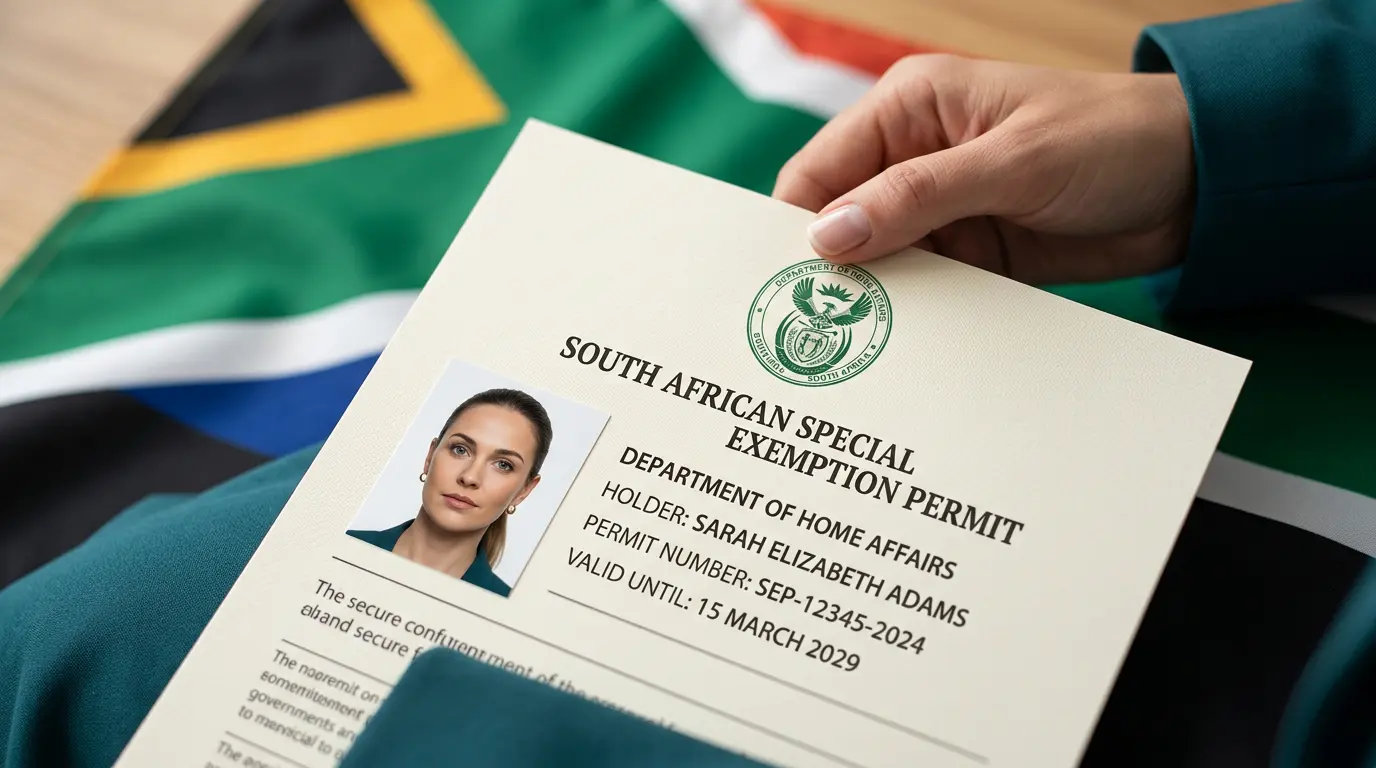

Key Takeaway
South Africa has issued special exemption permits to nationals of certain countries facing humanitarian crises or economic hardship, allowing them to reside, work, and study in the country outside the standard visa framework. These permits are issued by the Minister of Home Affairs under the special powers granted by the Immigration Act.
Special Exemption Permits - South Africa
Overview
South Africa has issued special exemption permits to nationals of certain countries facing humanitarian crises or economic hardship, allowing them to reside, work, and study in the country outside the standard visa framework. These permits are issued by the Minister of Home Affairs under the special powers granted by the Immigration Act.
ZIMBABWEAN EXEMPTION PERMIT (ZEP)
History
- 2009: The Dispensation for Zimbabweans Project (DZP) was launched to regularize the status of an estimated 1.5 million Zimbabweans living in South Africa without documentation
- 2010: DZP permits issued (valid until December 2014)
- 2014: Zimbabwe Special Permit (ZSP) replaced the DZP (valid until December 2017)
- 2017: Zimbabwean Exemption Permit (ZEP) replaced the ZSP (valid for 4 years)
- 2021: ZEP extended to December 2022
- 2022: Minister announced ZEP would NOT be renewed beyond December 2023, but would allow a 12-month grace period to apply for mainstream visas
- 2023: Grace period extended amid legal challenges
- 2024: Further extensions granted
- 2025: Minister's Immigration Directive No. 21 of 2025 extended ZEP to 28 May 2027
Current Status (February 2026)
- Valid until: 28 May 2027
- Extended by Minister's Immigration Directive No. 21 of 2025 (issued 7 October 2025)
- Automatic extension - no need to apply for renewal
- Current holders do NOT need to visit DHA or VFS to extend
Rights of ZEP Holders
- Right to reside in South Africa
- Right to work - can be employed by any employer
- Right to study - can enroll at educational institutions
- Right to conduct business
- Protected from arrest, deportation, or being declared undesirable for immigration status reasons
Restrictions
- No pathway to permanent residency - regardless of duration of stay in South Africa
- Cannot change immigration status during the validity of the permit
- Cannot apply for a different visa while holding the ZEP (must first exit the ZEP system)
- Time spent on ZEP does not count toward the 5-year requirement for permanent residency under Section 26(a)
After May 2027
- It is unlikely that there will be another extension after May 2027
- ZEP holders are strongly encouraged to apply for mainstream visas before the expiry date
- Options include:
- Critical Skills Work Visa (if occupation is on the Critical Skills List)
- General Work Visa (if meeting the 100-point threshold)
- Business Visa (if meeting the R5 million investment requirement)
- Study Visa (if enrolling in an educational institution)
- Relative's Visa (if married to or related to an SA citizen/PR)
- Those who do not obtain a mainstream visa by May 2027 will become illegal foreigners
Constitutional Court Challenge
- The Zimbabwe Community in South Africa (ZCSA) challenged the government's decision not to renew ZEPs
- The Constitutional Court has considered the matter
- Various court orders have influenced the extension timeline
- The legal battle has been ongoing since 2022
LESOTHO EXEMPTION PERMIT (LEP)
History
- 2016: Lesotho Special Permit (LSP) was introduced to regularize Lesotho nationals in SA
- 2019: Lesotho Exemption Permit (LEP) replaced the LSP
- 2023: LEP extended
- 2025: Minister's Immigration Directive No. 20 of 2025 extended LEP to 28 May 2027
Current Status (February 2026)
- Valid until: 28 May 2027
- Extended by Minister's Immigration Directive No. 20 of 2025 (issued 7 October 2025)
- Automatic extension - no need to apply for renewal
Rights and Restrictions
- Same rights as ZEP holders: work, study, reside, conduct business
- Same restrictions: no PR pathway, no status change, time does not count toward PR eligibility
- Protected from arrest or deportation during validity period
Special Context
- Lesotho is an enclave country (completely surrounded by South Africa)
- Significant cross-border movement and economic interdependence
- Many Lesotho nationals work in SA mining, agriculture, and domestic sectors
- The LEP addresses a unique geographic and economic relationship
VisaFlow
Want to automate your visa workflow?
Join hundreds of South African immigration firms using VisaFlow to manage cases, documents, and clients.
Learn more →ANGOLAN SPECIAL DISPENSATION
Background
- Special permits were issued to Angolan nationals who fled the civil war (1975-2002)
- Many were granted asylum or refugee status initially
- Some transitioned to special dispensation permits as the situation in Angola stabilized
Current Status
- Most Angolan special dispensation permits have been phased out
- Former holders were encouraged to apply for mainstream visas or permanent residency
- Those with refugee status may still hold valid permits
DRC (DEMOCRATIC REPUBLIC OF CONGO) CONSIDERATIONS
Background
- DRC nationals form a significant refugee and asylum seeker population in SA
- No formal "DRC Exemption Permit" exists comparable to ZEP/LEP
- DRC nationals primarily rely on the asylum/refugee system
- Some have been in South Africa for decades on renewable Section 22 (asylum seeker) or Section 24 (refugee) permits
Relevant Provisions
- Section 27(d) of the Immigration Act: Refugees with 10+ years continuous residence may apply for permanent residency
- This pathway is particularly relevant for long-standing DRC refugees
MINISTER'S IMMIGRATION DIRECTIVES 20 & 21 OF 2025
Directive No. 20 of 2025 (LEP Extension)
- Issued: 7 October 2025
- Effect: Extends all valid LEP permits until 28 May 2027
- Automatic: No action required by permit holders
- Authority: Issued by Minister Leon Schreiber under powers of the Immigration Act
Directive No. 21 of 2025 (ZEP Extension)
- Issued: 7 October 2025
- Effect: Extends all valid ZEP permits until 28 May 2027
- Automatic: No action required by permit holders
- Authority: Same as Directive 20
Practical Implications
- Employers can continue employing ZEP/LEP holders without concern
- Educational institutions can continue enrolling ZEP/LEP holders
- Banks and financial institutions should continue recognizing the permits
- ZEP/LEP holders should carry a copy of the relevant directive as proof of extension
IMMIGRATION ADVISORY BOARD (IAB)
Role in Exemption Permits
- The IAB was reconstituted effective April 2025
- Established under Section 4 of the Immigration Act
- Mandated to advise the Minister on immigration policy matters
- Will lead consultations to explore long-term solutions for exemption permit holders
- Expected to recommend a framework for transitioning exemption permit holders to mainstream visa categories
Composition
- Representatives from government departments
- Organized labour representatives
- Organized business representatives
- Civil society representatives
- Immigration experts
TRANSITIONING FROM EXEMPTION PERMIT TO MAINSTREAM VISA
Planning Checklist for ZEP/LEP Holders
Step 1: Assess eligibility for mainstream visas
- Identify which visa category best fits your circumstances
- Check if your occupation is on the Critical Skills List
- Calculate your points under the points-based system
- Assess if you qualify through family connections
Step 2: Gather documentation early
- Start SAQA evaluation of foreign qualifications (takes 3-6 months)
- Begin professional body registration process (if applicable)
- Obtain police clearance certificates from relevant countries
- Ensure passport is valid and has sufficient blank pages
Step 3: Financial preparation
- Gather 3-6 months of bank statements
- Ensure salary meets minimum thresholds for work visas
- If pursuing Business Visa, demonstrate R5 million investment capacity
Step 4: Apply before the expiry deadline
- Do NOT wait until May 2027 to apply
- Processing times can be 4-8 weeks for new applications
- Allow buffer for potential delays or refusals
Step 5: Employer engagement
- Inform your employer about the transition
- Request employment confirmation letter
- Ensure employer is willing to support work visa application
Most Viable Pathways
| Pathway | Requirements | Processing Time |
|---|---|---|
| Critical Skills Work Visa | Occupation on CSL + 100 points | 4-8 weeks |
| General Work Visa | Job offer + 100 points | 4-8 weeks |
| Spousal/Relative's Visa | SA citizen/PR spouse/relative | 4-8 weeks |
| Business Visa | R5M investment + DTIC letter | 8-12 weeks |
| Study Visa | Enrollment at SA institution | 4-6 weeks |
KEY SOURCES
- Minister's Immigration Directives: https://www.dha.gov.za
- EY Global Alert on ZEP/LEP Extension: https://www.ey.com/en_gl/technical/tax-alerts/south-africa-announces-extension-of-zimbabwean-exemption-permits
- Fragomen Alert: https://www.fragomen.com/insights/south-africa-lesotho-and-zimbabwean-nationals-now-eligible-for-automatically-extended-exemption-permits.html
- IBN ZEP/LEP Guide: https://www.ibn.co.za/blog-and-news/zep-and-lep-extension-2025/