
Key Takeaway
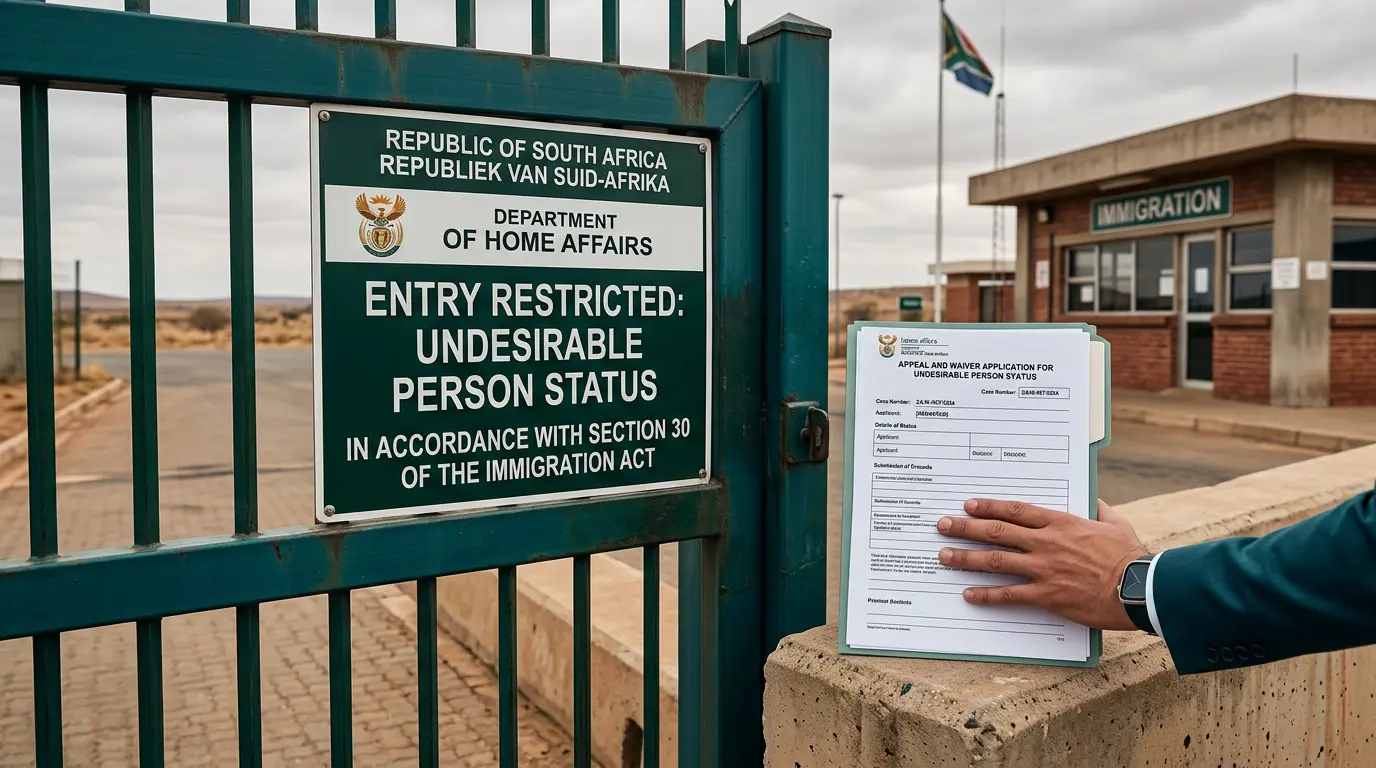
A person declared "undesirable" under the Immigration Act 13 of 2002 faces a ban on entry to South Africa and is barred from obtaining any visa or permit for the duration of the ban. Undesirable status is most commonly triggered by overstaying a visa, but can arise from several other grounds. The consequences are severe and can persist for years, but there are legal mechanisms to challenge or remove the declaration. Understanding the stop list system, the V-List codes, and the available remedies is critical for immigration practitioners.
Undesirable Person Status & Waivers - South Africa
Overview
A person declared "undesirable" under the Immigration Act 13 of 2002 faces a ban on entry to South Africa and is barred from obtaining any visa or permit for the duration of the ban. Undesirable status is most commonly triggered by overstaying a visa, but can arise from several other grounds. The consequences are severe and can persist for years, but there are legal mechanisms to challenge or remove the declaration. Understanding the stop list system, the V-List codes, and the available remedies is critical for immigration practitioners.
Legal Framework
Primary Legislation
- Section 30(1) of the Immigration Act 13 of 2002 - empowers the Director-General to declare a person undesirable
- Regulation 27(3) of the Immigration Regulations - prescribes the administrative process for undesirable declarations
- Directive 9 of 2014 - issued by the Director-General, provides detailed operational guidance on overstay declarations and the interaction between pending applications and visa expiry
Grounds for Undesirable Status
Section 30(1) sets out the following grounds upon which a person may be declared undesirable:
| Subsection | Ground | Description |
|---|---|---|
| Section 30(1)(a) | Public charge | Person who is or is likely to become a public charge (dependent on state resources) |
| Section 30(1)(b) | Ministerial identification | Person identified by the Minister as undesirable on grounds of public interest |
| Section 30(1)(c) | Incompetent person | Person who has been judicially declared incompetent |
| Section 30(1)(d) | Insolvent | An unrehabilitated insolvent |
| Section 30(1)(e) | Ordered to depart | Person who has been ordered to depart the Republic and has failed to do so |
| Section 30(1)(f) | Fugitive | Person who is a fugitive from justice in another country |
| Section 30(1)(g) | Criminal conviction | Person convicted of a criminal offence and sentenced to imprisonment without the option of a fine |
| Section 30(1)(h) | Overstay | Person who remained in South Africa beyond the expiry of their visa without authorisation |
Most Common Ground
Overstay under Section 30(1)(h) is by far the most frequently invoked ground. It is applied automatically at ports of departure when the immigration system detects that a person's visa expired before their departure date.
Overstay Consequences
| Duration of Overstay | Ban Period | V-List Code | Nature |
|---|---|---|---|
| Up to 30 days | 1 year | Code K | Temporary, appealable |
| More than 30 days | 5 years | Code K | Temporary, appealable |
| Deportation (any overstay) | Permanent | Code J | Permanent until rehabilitation |
Critical Warning: Pending Applications
- A pending visa application does NOT protect against an overstay declaration if the current visa expires while the application is being processed
- This is explicitly stated in Directive 9 of 2014
- Applicants whose visas expire during processing are deemed to have overstayed from the date of visa expiry, regardless of the pending application
- This creates a significant risk for applicants who submit renewal applications close to their visa expiry date
- Best practice: submit renewal applications at least 60 days before visa expiry
Process of Declaration
At Departure
- The person presents their passport at the immigration counter at a port of exit
- The immigration officer scans the passport against the Movement Control System (EMCS)
- The system calculates the number of overstay days by comparing the visa expiry date to the departure date
- If an overstay is detected, the officer issues Form 19 (Notice of Declaration as Undesirable Person)
- The officer updates the Movement Control System with the undesirable status
- The person is entered on the V-List with the appropriate code (Code K or Code J)
- The person is permitted to depart South Africa but the ban takes immediate effect
Form 19
- Official notice of the declaration
- Must be retained by the affected person as proof of the declaration
- Contains the grounds, the ban period, and information about appeal rights
- Issued at the port of departure or by DHA officials during enforcement operations
Stop List / EMCS (Enhanced Movement Control System)
System Overview
- DHA maintains the Enhanced Movement Control System (EMCS), commonly referred to as the "stop list"
- Operational at 72 ports of entry across South Africa (airports, land borders, seaports)
- Every passport is scanned against the V-List upon arrival and departure
- The system is linked to the Advanced Passenger Processing (APP) system, which enables pre-boarding flagging - airlines and carriers are required to transmit passenger data before departure, allowing DHA to flag persons on the V-List before they even board a flight to South Africa
Consequences of Being on the Stop List
- Denied entry at any South African port of entry
- Pre-boarding flagging may prevent boarding of flights to South Africa
- Visa applications will be refused
- No visa or permit may be issued while the person is on the V-List
V-List Codes
| Code | Meaning | Ban Duration | Removal Process |
|---|---|---|---|
| Code K | Undesirable person | Temporary (1 year or 5 years depending on overstay duration) | Appeal, upliftment application, or ministerial waiver |
| Code J | Prohibited/deported person | Permanent | Rehabilitation application only (requires 4-year absence) |
Code K - Undesirable
- Applied for overstays and most Section 30(1) grounds
- Temporary ban that expires automatically after the prescribed period (1 or 5 years)
- Can be removed before expiry through appeal or upliftment
- Person may re-enter South Africa and apply for visas once the ban period expires and the code is cleared
Code J - Prohibited/Deported
- Applied when a person has been physically deported from South Africa
- Permanent - does not expire automatically
- Requires a formal rehabilitation process to be removed
- Far more difficult to resolve than Code K
VisaFlow
Want to automate your visa workflow?
Join hundreds of South African immigration firms using VisaFlow to manage cases, documents, and clients.
Learn more →Removal Options
Option A: Overstay Appeal (Within 10 Working Days)
- Timeline: Must be lodged within 10 working days of the date of the Form 19 declaration
- Submission: Email to overstayappeals@dha.gov.za
- Target response time: 48 hours (per DHA internal targets)
- Actual processing time: 6-8 weeks in practice
- Requirements:
- Copy of Form 19
- Copy of passport biographical page and relevant visa pages
- Covering letter with grounds of appeal
- Supporting documentation (e.g., proof that visa was valid, evidence of pending application, medical emergency, force majeure)
- Outcome: If successful, the Code K entry is removed from the V-List
Option B: Upliftment Application (After Appeal Deadline)
- Timeline: Can be submitted after the 10-working-day appeal window has closed
- Processing time: 1-4 months in practice
- Submission: To DHA head office or the relevant provincial office
- Requirements:
- Completed application form
- Copy of passport
- Copy of Form 19 (if available)
- Detailed motivation letter explaining circumstances of the overstay
- Supporting documentation
- Outcome: Director-General exercises discretion to uplift the undesirable declaration
Option C: Ministerial Waiver - Section 30(2)
- Legal basis: Section 30(2) of the Immigration Act allows the Minister to waive an undesirable declaration for good cause
- Timeline: No time limit for submission; can be lodged at any point during the ban period
- Processing time: Variable, often several months
- Requirements:
- Written application to the Minister of Home Affairs
- Comprehensive motivation demonstrating "good cause"
- Supporting documentation (family ties, employment, humanitarian grounds, etc.)
- Outcome: Minister may waive the undesirable status entirely, allowing the person to apply for visas and enter South Africa
Option D: Rehabilitation (Code J Only)
- Applicable to: Persons with Code J (deported/prohibited) status only
- Requirements:
- Must have been absent from South Africa for at least 4 years
- Police clearance certificate from country of residence covering the 4-year period
- Sworn affidavit confirming the person has not contravened any immigration laws during the absence period
- Completed rehabilitation application form
- Copy of passport
- Processing time: Variable, typically several months
- Outcome: If successful, Code J is removed and the person may apply for visas and re-enter South Africa
Impact on Future Applications
Complete Bar on New Visas
- While on the V-List (Code K or Code J), no visa or permit application will be approved
- Applications submitted while on the V-List will be refused outright
- The system flags the applicant at the point of submission or adjudication
Refusal of Entry
- Person will be denied entry at any of the 72 ports of entry
- Immigration officers have no discretion to override the system flag
Pre-Boarding Flagging
- The Advanced Passenger Processing (APP) system may prevent boarding of flights to South Africa
- Airlines face penalties for transporting inadmissible persons and therefore comply with APP flags
Employment Consequences
- Loss of ability to work in South Africa
- Employer may face disruption and costs associated with replacing the employee
- Section 38 undertaking obligations may be triggered
Family Separation
- Persons with families in South Africa face prolonged separation during the ban period
- This has been raised as a constitutional concern in several court cases
How to Check If You Are on the Stop List
There is no online portal for checking V-List status. The following methods are available:
| Method | Description | Reliability |
|---|---|---|
| Attempted visa application | Submit a visa application; refusal on V-List grounds confirms status | High, but slow and costly |
| Contact DHA directly | Call or visit DHA offices and request a status check | Medium; response times vary |
| PAIA request | Submit a Promotion of Access to Information Act request for your EMCS records | Medium; formal process takes 30 days |
| Immigration attorney | Instruct an attorney to make enquiries on your behalf through established DHA channels | High; fastest reliable method |
| Form 19 document | If you were issued a Form 19 at departure, this confirms the declaration | High, but only available if issued at the time |
Legal Remedies
Administrative Remedies
| Remedy | Timeline | Forum |
|---|---|---|
| 10-day appeal | Within 10 working days of Form 19 | overstayappeals@dha.gov.za |
| Upliftment application | After appeal deadline | DHA Head Office / Provincial Office |
| Ministerial waiver (Section 30(2)) | Any time during ban | Minister of Home Affairs |
| Section 8 appeal | Where Director-General decision is contested | Internal DHA appeal process |
Judicial Remedies
| Remedy | Legal Basis | Timeline | Forum |
|---|---|---|---|
| High Court review | Promotion of Administrative Justice Act (PAJA), Section 6 | Within 180 days of the decision | High Court (Gauteng Division or relevant division) |
| Interim relief | Rule 6(12) Uniform Rules / Section 18(3) Superior Courts Act | Urgent application | High Court |
| Constitutional challenge | Section 33 of the Constitution (right to just administrative action) | No fixed limit | High Court / Constitutional Court |
Costs
- Judicial review is expensive and should be considered only where administrative remedies have been exhausted or are inadequate
- Legal Aid South Africa may provide assistance in certain cases
- The Pretoria High Court is the most common venue for immigration judicial reviews
White Paper Reform Proposal
Administrative Fines Replacing Blanket Bans
- The 2025 White Paper on International Migration proposes replacing the current blanket 1-year and 5-year ban system with administrative fines
- Under the proposal:
- Minor overstays (up to 30 days) would attract a fine rather than a ban
- Longer overstays would still attract a ban, but with the option of paying an administrative fine to reduce the ban period
- The aim is to create a more proportionate response that distinguishes between inadvertent short overstays and deliberate prolonged illegal presence
- This reform is not yet enacted and requires legislative amendment
- Immigration practitioners should monitor developments but continue advising based on the current ban framework
Key Contact
| Purpose | Contact |
|---|---|
| Overstay appeals (within 10 days) | overstayappeals@dha.gov.za |
| General DHA enquiries | haabornerefuge@dha.gov.za |
| DHA contact centre | 0800 60 11 90 |
Sources
- Immigration Act 13 of 2002, Section 30: https://www.gov.za/documents/immigration-act
- Immigration Regulations, Regulation 27(3): https://www.dha.gov.za/
- Directive 9 of 2014 (Director-General): Department of Home Affairs
- Promotion of Administrative Justice Act 3 of 2000 (PAJA): https://www.gov.za/documents/promotion-administrative-justice-act
- White Paper on International Migration (2025): https://www.dha.gov.za/
- DHA Movement Control System: https://www.dha.gov.za/
- High Court jurisprudence on overstay declarations: SAFLII (https://www.saflii.org/)